
Coffee berry disease
Colletotrichum kahawae
Description
Symptoms
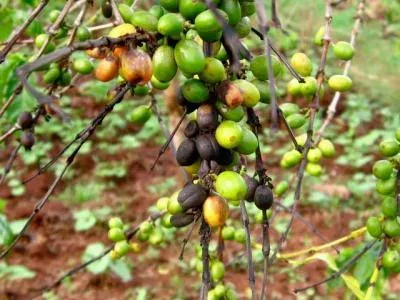
The first symptoms appear as small, dark, water-soaked lesions on the green berries. These lesions expand rapidly and darken, eventually turning into necrotic black patches.
Under conditions of high humidity, pale pink or orange spore masses often become visible on the surface of the lesions, indicating active sporulation of the fungus.
Flowers can also be affected, leading to "flower blight," where the blossoms blacken and fall off before fruit set, resulting in immediate yield loss.
Infected berries eventually become shriveled, hardened "mummies." These mummified fruits frequently remain attached to the branches, serving as a continuous source of inoculum.
Lesions can also appear on the stems, leading to dieback. This weakens the entire branch and reduces the tree's overall capacity to support a healthy crop.
Pathogen
The causative agent of this devastating plant disease is the fungus Colletotrichum kahawae. It is a highly specialized pathogen that targets coffee plants, specifically focusing on the berries.
The fungus is categorized as an ascomycete. It reproduces primarily through conidia, which are produced in acervuli structures that rupture the host's epidermal layer to release spores.
This pathogen has evolved to exploit the coffee plant's reproductive cycle. It infects the berries at various stages, but the most severe damage occurs during the transition from the green stage to ripening.
Mycelial growth penetrates the berry tissue, leading to structural breakdown. The pathogen thrives in humid environments, which are characteristic of many coffee-growing high-altitude regions.
The fungus overwinters in mummified berries and bark tissues, maintaining its presence within the plantation to ensure infection of the next season's crop.
Conditions for development
The development of Colletotrichum kahawae is highly dependent on climatic conditions. High relative humidity and frequent rainfall are the primary drivers of disease spread.
Temperatures ranging between 18°C and 24°C are optimal for the fungus. These mild temperatures, combined with moisture, create a perfect environment for infection.
Densely planted orchards often struggle with air circulation, leading to prolonged leaf and berry wetness. This wetness is essential for spore germination and colonization.
Frequent fog and drizzling rain facilitate the dispersal of spores by splash action, moving the pathogen from infected berries to healthy ones on the same or adjacent trees.
Cultural practices that lead to a humid, stagnant microclimate within the canopy significantly increase the severity of the disease outbreaks.
Why it matters
Coffee Berry Disease (CBD) is arguably one of the most economically damaging threats to Arabica coffee production globally, capable of destroying up to 80% of a harvest.
The impact goes beyond quantity; the quality of the harvested beans is severely compromised. Beans from infected berries often exhibit sensory defects, making them unsuitable for trade.
The disease places a heavy physiological burden on the trees. Managing the infection requires significant energy from the plant, leading to stunted growth and reduced productivity.
The potential for rapid spread means that an uncontrolled outbreak can devastate an entire plantation within a single growing season.
Financial losses also arise from the intensive management costs, including the continuous application of fungicides and the labor-intensive removal of infected plant parts.
Protection
The most sustainable strategy for managing the disease is the planting of resistant or tolerant coffee varieties. Breeding programs are essential for long-term survival in affected regions.
Cultural control measures, such as systematic pruning, are vital. Removing infected branches and mummified berries reduces the primary inoculum reservoir.
Improved plantation management, including proper spacing and shade control, helps promote airflow, reducing the humidity levels that the fungus requires to thrive.
- Application of copper-based fungicides during critical growth stages.
- Strict monitoring of fields for the first signs of lesion development.
- Sanitation protocols to clear plant debris from the ground.
Chemical control must be applied preventatively. Once the fungus has penetrated the berry tissue, surface-applied fungicides are significantly less effective at stopping the damage.
Discussion
No discussions yet — be the first.