
Anthracnose of cucurbits
Colletotrichum bryoniicola
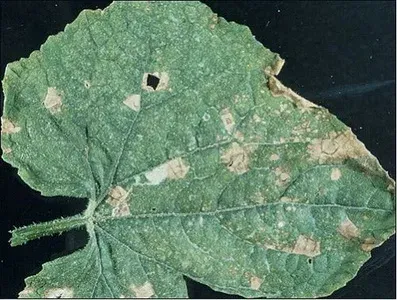
Description
Symptoms
Symptoms initially appear on cotyledons and leaves as small, yellow-to-brown, circular or angular spots. Over time, these spots darken, expand, and may coalesce to cover large portions of the leaf tissue.
Deep, elongated lesions often form on stems and petioles. These can lead to structural weakness, causing stems to become brittle and eventually leading to the wilting and collapse of entire vines.
Fruit infection is highly characteristic, manifesting as sunken, circular spots that eventually develop a pink or yellowish mass of fungal spores in the center.
Under high humidity, small black dots known as acervuli appear within the lesions. These are often arranged in concentric circles, which is a hallmark sign of this specific pathogen.
- Yellowing and necrosis of foliage.
- Sunken lesions on fruits and stems.
- Deformation and premature death of shoots.
- Post-harvest decay of infected fruits.
- Reduced vigor and stunted plant growth.
Pathogen
The causal agent of this disease is the imperfect fungus Colletotrichum bryoniicola. This pathogen is highly specialized and affects only the Cucurbitaceae family, including cucumbers, zucchini, pumpkins, melons, and watermelons.
The fungus spreads via conidia, which are dispersed by wind, splashing rain, or overhead irrigation. It can persist in the soil and on crop residues as mycelium or sclerotia for several years.
Initial infection typically occurs through contaminated seeds or contact with infested soil. Secondary infections spread rapidly throughout the growing season, especially in humid conditions.
The pathogen invades plant tissues through natural openings like stomata or physical wounds. Once inside, the mycelium spreads rapidly between cells, causing localized necrosis and tissue death.
The biological nature of the pathogen makes it well-adapted to surviving unfavorable conditions, which presents a significant challenge for long-term field management.
Conditions for development
The optimal temperature for anthracnose development ranges between +22…+27 °C. High relative humidity (above 90%) and the presence of free water on plant surfaces are essential for spore germination.
Frequent rainfall, heavy fogs, and dew during the night provide perfect conditions for the pathogen to thrive. Poor ventilation in greenhouses and overcrowding of plants drastically increase disease incidence.
Overhead irrigation is a primary driver for the spread of spores from infected to healthy plant parts. Nutritional deficiencies and mechanical damage make plants more susceptible to the fungal attack.
The latent period of the disease can be as short as a few days, allowing for rapid secondary spread. Once established, the fungus can produce new crops of spores repeatedly throughout the season.
Warm nights facilitate the rapid accumulation of inoculum, which can lead to severe outbreaks that are difficult to control without prompt intervention.
Why it matters
Anthracnose causes significant economic losses, often reducing total yields by 30–50% or more. Severe leaf damage reduces photosynthesis, leading to smaller fruit sizes and lower overall productivity.
Stem infections can kill entire plants, significantly reducing plant density in the field. Infected fruits are aesthetically unpleasing and usually lose all market value, becoming totally unusable.
Latent infections on fruits harvested while appearing healthy often manifest as rapid rot during storage or transit, leading to the loss of entire batches of produce.
In early growth stages, the disease can wipe out seedlings, necessitating costly replanting efforts and increasing total production expenses for the grower.
The necessity for frequent fungicide applications adds substantially to the cost of production, thereby decreasing the overall profitability of cucurbit cultivation.
Protection
The primary control strategy involves using high-quality, disease-free seeds and performing seed treatment. Deep plowing of crop residues is essential to destroy the overwintering inoculum.
Strict crop rotation, waiting at least 3–4 years before replanting cucurbits in the same area, is critical. Weed management is also vital to remove alternative hosts for the fungus.
In greenhouse settings, maintaining proper temperature and humidity through ventilation is key. Drip irrigation should be used instead of overhead watering to keep foliage dry.
When initial symptoms are detected, contact and systemic fungicides containing copper, triazoles, or strobilurins should be applied to halt the spread of the infection.
Preventive sprays are recommended during high-risk periods, such as after rainfall, while strictly adhering to pre-harvest intervals to ensure consumer safety.
Discussion
No discussions yet — be the first.