
Anthracnose of crucifers
Colletotrichum brassicicola
Description
Symptoms
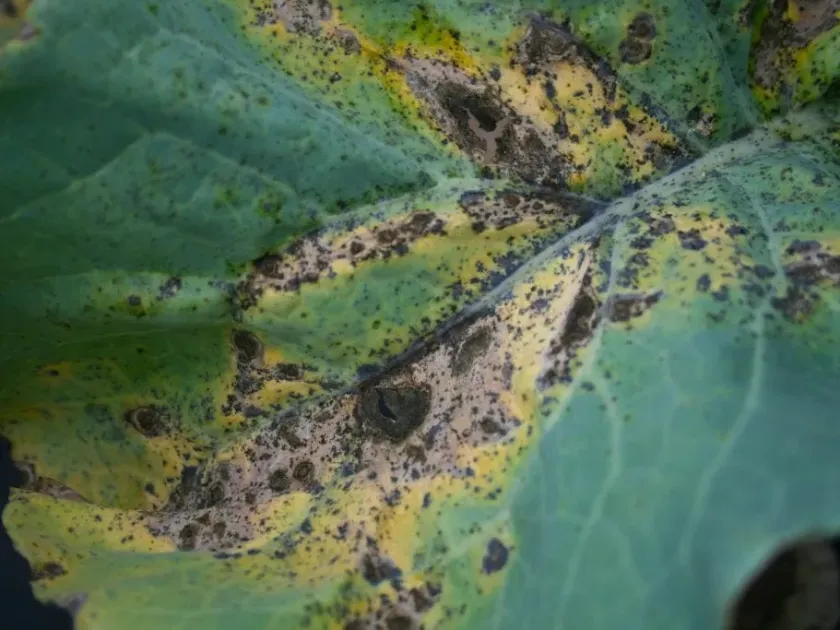
Initial symptoms manifest as small yellowish or light brown spots on cotyledons and leaves. Over time, these spots expand, turn brown, and develop a distinct, dark-colored margin.
The center of necrotic spots often cracks or falls out, resulting in a shot-hole appearance. Under magnification, small black dots known as acervuli can be observed within the lesions, which are masses of fungal spores.
Lesions on stems and petioles appear as elongated, sunken, grey or brown spots. Under conditions of high humidity, a faint pinkish or greyish fungal mycelium may become visible on these affected areas.
In cases of severe infection, leaf deformation and premature wilting occur. If the infection reaches the growing point, the plant ceases growth and often dies during the early stages of vegetation.
When inflorescences and pods are affected, seed quality decreases significantly. Infected pods often twist or split prematurely, resulting in substantial yield losses prior to harvest.
Pathogen
The causal agent of this disease is the imperfect fungus Colletotrichum brassicicola. This pathogen belongs to the Deuteromycetes class and can persist in soil, on plant debris, and within seed lots as mycelium or conidia.
The fungus develops its mycelium within host plant tissues, destroying cells and producing conidial sporulation. Fungal spores are disseminated via wind currents, splashing rain, or irrigation water, facilitating rapid spread throughout the field.
The lifecycle of the pathogen includes active infection phases during the growing season and resting phases during off-seasons. Its ability to survive on weeds within the Brassicaceae family complicates the elimination of infection sources on the field.
The fungus exhibits high virulence specifically under conditions of high humidity, common in regions with frequent rainfall. The pathogen is capable of attacking plants at all developmental stages, from seedling emergence to full maturity.
Studies indicate that mycelium can penetrate deep into the seed coat, making seeds a primary vector for seedling infection. Understanding the biology of Colletotrichum brassicicola is essential for designing effective crop rotation strategies.
Conditions for development
Anthracnose development is facilitated by prolonged wet weather and high relative humidity (above 80-85%). Water acts as the primary vector for transporting spores from one plant to another.
The optimal temperature for active mycelial growth ranges from +20°C to +25°C. However, the pathogen can remain active at lower temperatures provided that surface moisture on leaves remains high.
Dense crop stands create a microclimate favorable for fungal development by hindering airflow and delaying the drying of dew or rain on leaves. Poor ventilation is a major driver of rapid infection spread.
The presence of cruciferous weeds, such as shepherd's purse or field mustard, provides a continuous reservoir for the pathogen throughout the season. Failure to implement proper crop rotation contributes to spore buildup in the soil.
Injuries caused by insect pests, such as flea beetles or root maggots, provide entry points for the mycelium to penetrate healthy tissues, significantly accelerating the development of an epidemic.
Why it matters
The primary damage consists of a significant reduction in photosynthetic leaf area, which leads to a sharp decline in plant vigor and overall yield potential.
When seedlings are attacked, mass mortality occurs, often referred to as damping-off, which results in thin stands and the necessity for costly replanting.
The disease significantly degrades the marketability of the produce. Cabbage heads or radish roots affected by anthracnose exhibit reduced shelf life and are prone to rapid rot during storage.
Seed-bearing crops suffer from reduced germination energy and viability. Contaminated seeds, once sown, create primary infection centers that can jeopardize the crop across a large area.
Economic losses during severe outbreaks can range from 30% to 50% or more, particularly during wet summers, making the control of this pathogen an economic necessity for commercial farming.
Protection
Using healthy, certified, and fungicide-treated seeds is the first and most critical line of defense. Seed treatment helps eliminate latent infections within the seed coat.
Implementing a crop rotation schedule that avoids planting Brassicaceae for 3 to 4 years helps significantly reduce the infectious background in the soil.
Agrotechnical measures include regular weed control to eliminate reservoir hosts and thorough incorporation of crop residues into the soil after harvest. Deep plowing facilitates rapid decomposition and pathogen destruction.
During the growing season, the application of fungicides is recommended upon the first signs of disease. Effective treatments include copper-based compounds as well as systemic triazole and strobilurin fungicides.
Optimizing plant spacing and ensuring good airflow across the field reduces microclimate humidity, creating conditions that are less suitable for the active sporulation of Colletotrichum brassicicola.
Discussion
No discussions yet — be the first.