
Collema furfuraceum
Collema furfuraceum
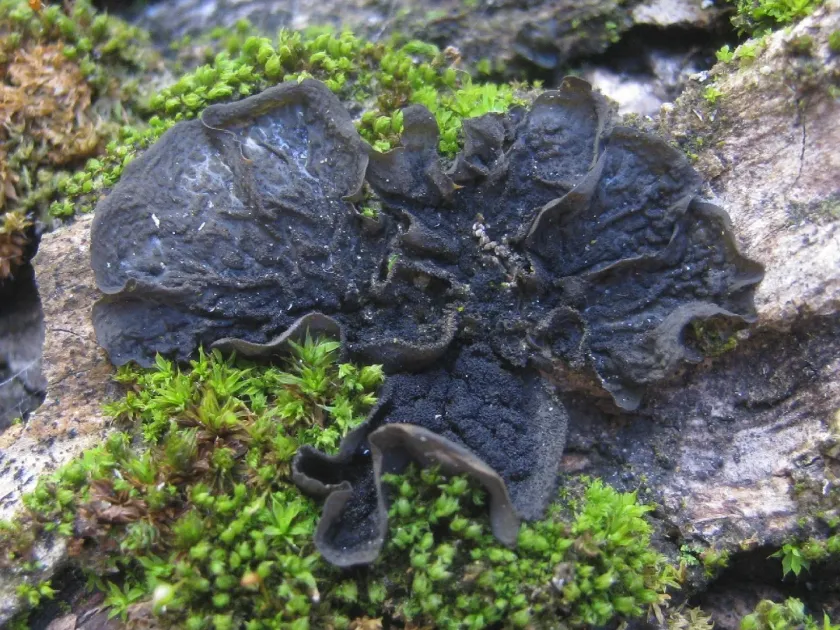
Description
Symptoms
Collema furfuraceum is a foliose lichen that commonly appears on the bark of deciduous trees. It is characterized by a dark grey to blackish thallus that changes color and texture depending on moisture levels.
The lichen features ruffled or wrinkled lobes, often with edges that curl upward. In dry conditions, the thallus is brittle and rigid, while in moist weather, it becomes soft and gelatinous to the touch.
The surface of the thallus is covered in small, granular structures known as isidia, which give the lichen a rough, "bran-like" appearance, hence the common and scientific names.
Collema furfuraceum is typically found growing on the trunks and main branches of mature trees. It attaches itself firmly to the bark but does not penetrate the cambium or cause direct structural damage to the plant.
Visual identification is fairly straightforward, especially during or after rain when the colony becomes significantly larger and more noticeable against the bark surface.
Pathogen
Biologically, Collema furfuraceum is a symbiotic organism comprised of an ascomycete fungus and a cyanobacterium of the genus Nostoc. This partnership allows it to thrive in diverse environments.
It is not a parasite in the botanical sense; it does not draw nutrients from the host tree. It is strictly an epiphyte, using the tree merely as a substrate for physical anchorage.
The growth rate of this lichen is exceptionally slow. It takes years to establish a noticeable colony, which is why it is rarely seen on fast-growing young saplings with smooth, rapidly expanding bark.
Reproduction occurs primarily through vegetative fragmentation. Small pieces of the thallus or individual isidia are dispersed by wind, rain, or insects to colonize new parts of the bark.
While not a disease-causing agent, it acts as a bio-indicator. Its presence suggests stable, humid conditions and relatively clean air, as it is sensitive to atmospheric pollution.
Conditions for development
High relative humidity is the primary driver for the development of Collema furfuraceum. Environments with poor air circulation, such as dense, unpruned tree canopies, are ideal for its establishment.
Light availability is also critical. This species prefers shaded or semi-shaded areas of the trunk, where moisture is retained for longer periods compared to sun-exposed surfaces.
The age and condition of the bark are significant. Rough, fissured bark on older trees provides more surface area and shelter for the lichen to gain a firm hold compared to smooth-barked trees.
Optimal growth occurs during periods of frequent rainfall and mild temperatures. It avoids extreme desiccation, making it most visible and active during cool, damp growing seasons.
Neglected orchards that lack proper sanitary maintenance are the most susceptible to widespread lichen colonization, as the trees often have lower vigor and thicker, aged bark.
Why it matters
Collema furfuraceum does not cause direct harm to tree tissues. However, thick layers of lichen can create a micro-habitat for various pests, including scale insects and mites, which hide beneath the lobes.
Excessive coverage may slightly inhibit gas exchange on the bark surface. In extreme cases, this can lead to moisture trapping, which promotes the growth of secondary fungi or decay in minor bark fissures.
The accumulation of lichen is often a symptom of reduced tree vigor. While the lichen itself is harmless, its presence can indicate that the tree is growing slowly or is not receiving proper care.
From a horticultural standpoint, heavy lichen coverage is considered unsightly and complicates the monitoring of the bark for actual diseases or pest infestations.
It is important to differentiate between a healthy presence of epiphytes and an overgrown state that requires intervention to ensure the tree's long-term vitality.
Protection
Sanitary pruning is the most effective preventative measure. By opening up the canopy, you improve air circulation and light penetration, creating conditions that are inhospitable to lichen growth.
Mechanical removal using soft-bristled brushes or plastic scrapers is recommended during the dormant season. Care must be taken not to gouge the living bark while cleaning the surface.
Applying a lime wash or white latex-based paint to the trunks after cleaning helps protect the bark and creates an alkaline surface that discourages the settling of lichen spores.
Early spring treatments with copper-based fungicides are highly effective at disinfecting the bark surface and killing established colonies, acting as both a preventative and a curative measure.
Maintaining optimal tree health through regular fertilization and adequate watering encourages rapid bark growth and tree vigor, which makes it much harder for lichen colonies to take root.
Discussion
No discussions yet — be the first.