
Clarohilum henningsii
Clarohilum henningsii
Description
Symptoms
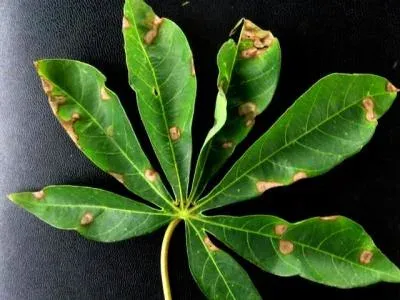
Early symptoms of the disease appear as small, chlorotic spots on the leaves. As the infection progresses, these spots expand, change color, and often develop a necrotic center surrounded by a yellowish halo.
In severe cases, the necrosis affects larger areas of the leaf, leading to wilting and premature drying. The structural integrity of the leaf is compromised, reducing the plant's overall photosynthetic capacity.
Stem infection is another common sign, manifesting as depressed, elongated lesions. These lesions can obstruct the xylem and phloem, restricting the flow of water and nutrients to the upper parts of the plant.
Visible mycelial growth might be observed on the underside of the leaves during high-humidity periods, appearing as a delicate, fuzzy coating. This is a clear indicator that the fungus is actively reproducing.
- Spotted necrosis on leaves.
- Chlorosis around infected areas.
- Premature leaf drop.
- Stunted growth of new shoots.
- Stem lesions inhibiting nutrient flow.
Pathogen
The disease is caused by the fungus Clarohilum henningsii, a pathogen that infects the epidermal and cortical tissues of various plant species. It belongs to the group of fungi known for their parasitic behavior in temperate and humid climates.
The life cycle of the pathogen is centered around the production of conidia, which act as the primary inoculants. These spores are dispersed by wind, water splashes, and physical contact, allowing the fungus to colonize new plant tissues efficiently.
The mycelium of the pathogen is highly invasive, capable of penetrating the host cell walls by secreting specific enzymes. This enables the fungus to derive nutrients from the living plant tissue, eventually causing localized cell death.
Scientific studies indicate that the fungus persists in soil and crop debris during the dormant season. This survival strategy makes it a persistent threat that can emerge whenever conditions become favorable.
Identification of Clarohilum henningsii often involves observing characteristic sporulation patterns on infected parts, which under a microscope reveal the specific morphology of its conidiophores.
Conditions for development
The development of Clarohilum henningsii is heavily dependent on moisture. High relative humidity and prolonged leaf wetness are essential for the germination of fungal spores on the plant surface.
Moderate temperatures ranging from 18°C to 25°C provide the optimal environment for the fungus to colonize tissues rapidly. Lower or significantly higher temperatures tend to slow down the infection rate.
Agricultural practices that promote high plant density often create a microclimate with reduced air circulation. This humidity trap becomes an ideal breeding ground for the pathogen to spread from plant to plant.
Plants under nutrient stress are generally more susceptible to the disease. A deficiency in essential microelements can weaken the host plant's defense mechanisms, making it an easy target for the fungus.
Consistent rainfall or heavy morning dew patterns during the growing season significantly increase the risk of an epidemic, especially in fields with poor drainage or high pathogen presence.
Why it matters
The economic impact of Clarohilum henningsii is primarily felt through reduced crop yield. By damaging the leaf canopy, the pathogen prevents the plant from producing enough carbohydrates to support fruit or seed development.
Beyond yield reduction, the quality of the harvested product is often compromised. Infected tissues are more prone to secondary infections by bacteria and molds, which significantly decrease shelf life and market value.
Persistent infection weakens the plant's overall health, making it less resilient to environmental stressors like drought or temperature fluctuations. This leads to long-term decline in productive capacity.
In fields with high disease pressure, the costs associated with repeated fungicide applications can drastically cut into the profit margins of the farming operation.
If not managed properly, the disease can lead to total crop failure, particularly in susceptible varieties grown in environments that favor the pathogen's development.
Protection
Management of the disease requires an integrated approach. The first line of defense is the selection of resistant cultivars, which significantly reduces the need for chemical intervention.
Crop rotation remains one of the most effective cultural practices, as it helps break the pathogen's life cycle. Planting non-host crops in infested fields for at least two to three seasons is recommended.
Chemical control involving fungicides should be applied during the early stages of symptom appearance. Systemic fungicides are particularly effective at halting the spread of the fungus within the plant tissues.
Biological control agents, such as beneficial fungi or bacteria that compete with the pathogen, can be used to manage infection levels in organic or sustainable agricultural systems.
Sanitation practices, including the removal and destruction of crop residues, play a critical role in minimizing the primary inoculum for the subsequent growing season.
Discussion
No discussions yet — be the first.