
Colocasia cladosporium leaf spot
Cladosporium colocasiae
Description
Symptoms
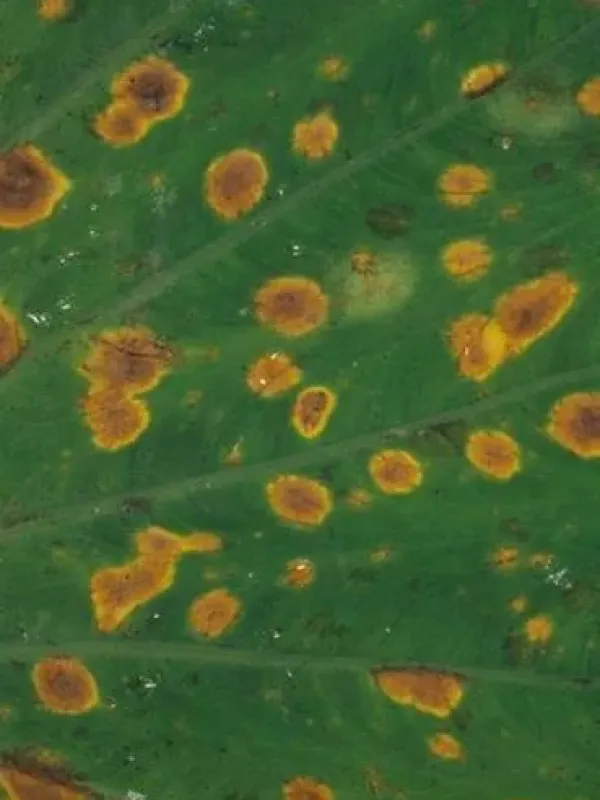
The disease first manifests as small, chlorotic spots on the leaves. As the infection develops, these spots turn brown or dark olive, often with a darker margin.
The lesions are generally circular or irregular in shape and increase in size as the fungal colony expands across the leaf surface.
A distinctive velvety, dark-colored mold is visible in the center of the necrotic spots, indicating mature sporulation of the fungus.
In severe cases, individual spots coalesce to form large necrotic patches, leading to the collapse of the leaf blade and premature drying.
- Initial yellow spots (chlorosis).
- Dark, olive-colored fungal growth.
- Lesion coalescence and leaf necrosis.
- Premature leaf senescence and wilting.
Pathogen
The causal agent of this disease is the fungus Cladosporium colocasiae. It is a specialized pathogen that primarily targets plants within the Araceae family.
The fungus is characterized by its dark-pigmented mycelium and conidia. These spores are easily disseminated by wind currents and water splashes during rainfall.
Cladosporium colocasiae operates as a necrotrophic parasite, invading the leaf tissues and deriving nutrients from the host cells.
Under suitable conditions, the fungus produces conidiophores that emerge from the leaf surface, appearing as a characteristic fuzzy, olive-green mass.
The life cycle of this pathogen is highly efficient in tropical environments, allowing for rapid colonization of healthy host tissues.
Conditions for development
High relative humidity (above 80%) is the most critical environmental factor for the development and spread of Cladosporium colocasiae.
The fungus thrives in moderate to warm temperatures, typically ranging from +20°C to +28°C, which is consistent with tropical growing climates.
Poor ventilation within dense plant populations creates microclimates with stagnant air, promoting the accumulation of inoculum and infection.
Moisture on the leaf surface, caused by dew, high humidity, or overhead irrigation, is necessary for the germination of fungal spores.
Prolonged rainy seasons provide a continuous source of water, drastically increasing the severity and incidence of leaf spot outbreaks.
Why it matters
The primary impact of the disease is the reduction of the functional photosynthetic area, which directly impairs the plant's ability to produce energy.
Reduced photosynthetic efficiency leads to stunted plant growth and a significant decrease in the accumulation of starch in the corms or tubers.
Heavy defoliation can lead to substantial yield losses, sometimes exceeding 40% in vulnerable Colocasia varieties under severe weather conditions.
The presence of necrotic lesions significantly degrades the market quality of the leaves, which are often used for culinary purposes in many cultures.
Weakened plants are prone to secondary infections from other pathogens, further threatening the overall stability of the crop production system.
Protection
Cultural practices such as maintaining adequate plant spacing are essential to improve air circulation and reduce humidity levels within the canopy.
Sanitation plays a crucial role in management; infected leaves should be promptly removed and destroyed to minimize the spread of fungal spores.
Fungicidal applications, particularly those containing copper or specialized systemic agents, can be effective if applied during the early stages of disease.
Crop rotation and selecting disease-resistant cultivars are recommended as long-term strategies for sustainable disease management in affected regions.
Monitoring the field for initial symptoms is vital, as early detection allows for targeted intervention and helps prevent widespread outbreaks.
Discussion
No discussions yet — be the first.