
Chrysomyxa himalensis
Chrysomyxa himalensis
Description
Symptoms
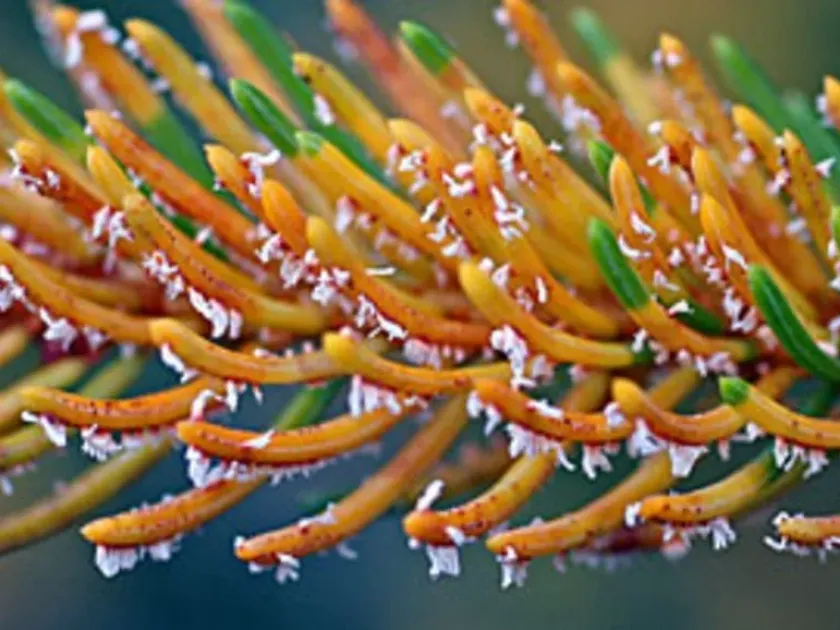
The primary symptom of infection is the appearance of characteristic yellow or orange spots on the needles, which gradually spread across the surface.
During the active sporulation phase, bright orange or golden-yellow pustules (aecia) develop on the undersides of the needles.
Massive infection causes the spruce needles to turn yellow prematurely, dry out, and drop off, leading to significant defoliation in the lower crown.
The trees appear stunted and unhealthy, while the aesthetic value of the conifer planting is significantly reduced due to loss of foliage density and color.
- Needle yellowing during spring and summer.
- Appearance of bright orange spore pustules.
- Premature needle drop (defoliation).
- Drying and deformation of young shoots.
Pathogen
The causative agent of the disease is a specialized fungus, Chrysomyxa himalensis, which belongs to the group of rust fungi of the order Pucciniales.
This microscopic pathogen is an obligate parasite, infecting exclusively coniferous tree species, primarily those belonging to the genus spruce (Picea).
The fungus has a complex life cycle, typical of rust pathogens, which ensures its survival and successful adaptation within forest ecosystems.
The infection persists as spores on infected needles, from where it spreads to healthy trees during favorable weather conditions via air currents.
The fungus penetrates deep into the needle tissues, utilizing nutrients from the host plant to support its vegetative growth and sporulation.
Conditions for development
The development of the disease is directly dependent on meteorological factors, particularly air humidity levels and temperature during the spring season.
High relative humidity, frequent fog, and prolonged rainfall promote rapid spore germination and successful colonization of spruce needle tissues.
The disease spreads most intensely in dense plantations where natural air circulation is restricted, leading to high moisture accumulation.
Older, weakened, or pest-damaged trees are significantly more susceptible to infection by this fungal pathogen compared to healthy specimens.
The period of most intensive infection usually coincides with the bud break phase and the rapid growth of young needles, which are highly vulnerable to spores.
Why it matters
Chrysomyxa himalensis causes considerable harm by inducing premature defoliation, which impairs photosynthesis and slows down the growth of spruce trees.
Repeated severe infections over several consecutive years exhaust the tree, making it highly susceptible to secondary pests, such as bark beetles.
In ornamental nurseries, the disease can cause the total loss of seedlings or reduce their marketability, leading to significant financial losses.
In forest stands, the pathogen contributes to decreased overall wood productivity and disrupts the resilience of conifers to environmental stressors.
The economic impact includes costs for sanitation measures, wood quality loss, and the expense of restoring degraded forest areas.
Protection
The primary prevention method is adherence to cultural practices, such as avoiding high-density planting to ensure optimal air circulation within the tree canopy.
It is crucial to promptly remove and destroy fallen infected needles, as the fungus overwinters and survives in the debris on the forest floor.
Upon detection of initial symptoms, spraying with copper-based fungicides or other specific anti-rust agents is recommended to curb the infection.
Nursery management should prioritize regular monitoring of needle health during the critical spring growth phase to catch outbreaks early.
Establishing healthy, biologically resilient stands through careful species selection remains a long-term strategy for protection against this pathogen.
Discussion
No discussions yet — be the first.