
Green elfcup
Chlorociboria aeruginascens
Description
Symptoms
The primary visual sign of infection is an anomalous staining of the wood into a deep blue-green color. This hue remains stable even after the wood has dried completely.
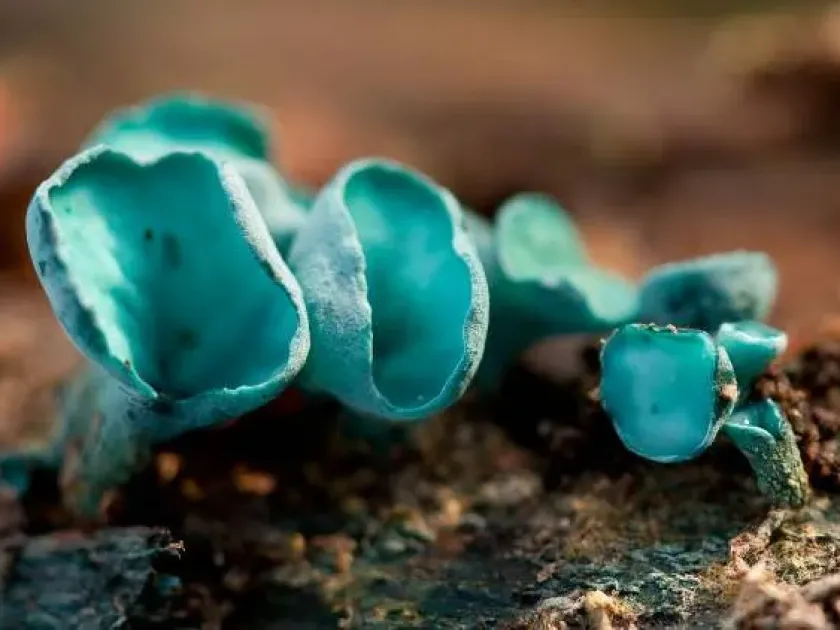
On the surface of decaying branches or trunks, one can observe the fungus's fruiting bodies: small, disc-shaped or cup-shaped structures in bright blue or turquoise tones.
Infected wood eventually becomes brittle, loses its structural strength, and tends to splinter along the grain when subjected to mechanical force.
Microscopic analysis of the timber reveals fungal hyphae occupying cell cavities and intercellular spaces, which hinders the natural movement of nutrients and water within the wood structure.
Unlike common "blue stain" fungi found in conifers, the pigment produced by Chlorociboria is highly persistent and penetrates deeply into the timber.
Pathogen
Chlorociboria aeruginascens is a saprobic fungus belonging to the Helotiaceae family. It is a specialized wood-decaying pathogen that causes a distinctive green-blue staining of the substrate.
The fungal mycelium permeates the cell walls of the wood, secreting a unique pigment called xylindein. This metabolite is responsible for the characteristic bright blue-green or turquoise color of the infected material.
The pathogen's life cycle includes the production of small, cup-shaped fruiting bodies that emerge directly from the substrate during periods of high humidity.
It typically affects deciduous trees such as oak, beech, alder, and willow, preferring fallen logs or weakened specimens within forest ecosystems.
Unlike many other aggressive pathogens, this fungus does not kill trees immediately but slowly decomposes the structural components of the wood, utilizing cellulose and lignin as energy sources for growth.
Conditions for development
The development of the fungus is directly dependent on the moisture content of the wood. Optimal conditions for colonization occur when substrate moisture exceeds 25-30%.
Temperature plays a secondary role, although the fungus spreads most effectively in moderately warm conditions with a constant oxygen supply.
Spore dispersal occurs primarily through air currents or via direct contact between healthy wood and already infected organic residues in the forest floor.
Moisture accumulation and poor ventilation in timber storage areas create perfect conditions for the pathogen to colonize new stacks of wood.
The fungus is most active during spring and autumn, when frequent precipitation and high ambient humidity facilitate its growth cycle.
Why it matters
The primary economic damage is the reduction in the market value of timber. The intense pigmentation makes the wood unsuitable for high-quality joinery and decorative carpentry.
While not an aggressive parasite of healthy trees, the fungus accelerates the decomposition of woody debris, which can create a pathway for secondary pests to enter the wood.
Although "green wood" is sometimes appreciated in artistic woodturning and specialized crafts, its presence is generally considered a sign of material degradation in commercial forestry.
Infection results in the loss of physical and mechanical properties, rendering the wood unfit for load-bearing applications in construction.
Long-term exposure leads to the structural decomposition of cellulose, eventually reducing the timber to soft, unusable waste material.
Protection
The primary preventative measure is timely sanitary felling and the removal of infected wood debris from the forest to reduce the overall inoculum density.
Proper timber storage is the most critical step for protection. It is essential to ensure good ventilation of stacks and avoid direct contact between wood and the soil.
The use of antiseptic treatments and wood preservatives helps prevent colonization by fungal spores during the initial stages of harvesting and processing.
Maintaining a low moisture content (below 20%) effectively halts the development of Chlorociboria mycelium, as the fungus loses its ability to grow when the wood dries out.
- Regular monitoring of forest stand health.
- Clearing areas of fallen wood and dead standing trees.
- Rapid processing of harvested timber.
- Applying quality fungicides during storage periods.
Discussion
No discussions yet — be the first.