
Rapid Ohia Death
Ceratocystis lukuohia
Description
Symptoms
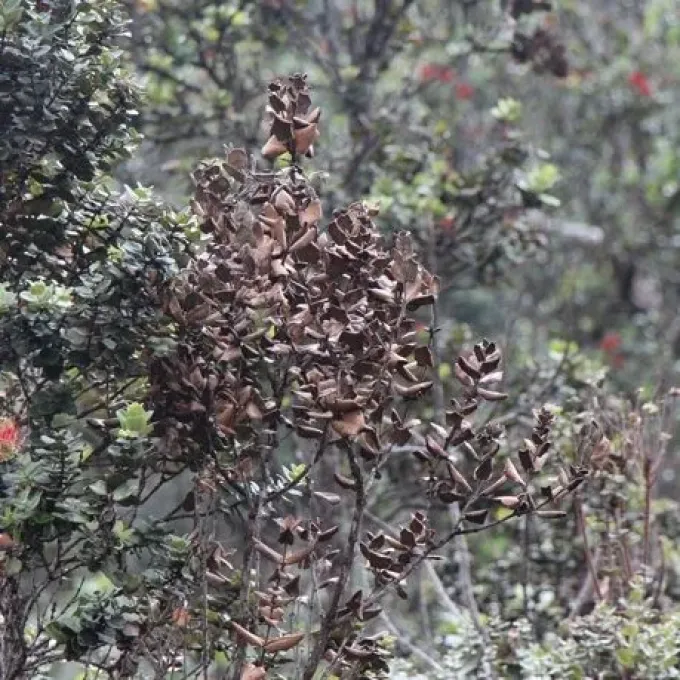
The primary symptom is a sudden yellowing or browning of leaves on one or more branches of the tree crown. This color change happens rapidly, often within just a few weeks.
Affected trees often show a full canopy browning while the leaves remain attached to the branches, a hallmark feature that distinguishes this disease from others.
Upon removing the bark, you will notice dark, necrotic staining in the sapwood, which indicates where the fungus has colonized the wood tissue.
Trees affected by Ceratocystis lukuohia often die completely, while trees infected with Ceratocystis huliohia may show signs of stress or branch dieback over a longer period.
Once the tree dies, the structure of the wood becomes brittle and susceptible to secondary decay, often attracting boring beetles that accelerate the decay process.
Pathogen
Rapid Ohia Death (ROD) is caused by two fungal species in the Ceratocystis genus, namely Ceratocystis lukuohia and Ceratocystis huliohia. These pathogens infect the tree through wounds, colonizing the sapwood and blocking the water-conducting vessels.
The host plant is Metrosideros polymorpha, commonly known as Ohia lehua. This tree is the backbone of native Hawaiian forests, supporting unique biological diversity.
As a vascular wilt disease, the fungus spreads through the tree's xylem, causing widespread wilting and eventual necrosis. The pathogen thrives within the tree's internal transport system.
The fungal spores are highly mobile and can be spread through wind, rain splash, insects, and by human activity involving infected soil or wood debris.
Scientific studies indicate that C. lukuohia is significantly more aggressive, causing faster death of infected trees compared to C. huliohia.
Conditions for development
Infection primarily occurs through wounds on the tree trunk or branches. These wounds provide an entry point for fungal spores to colonize the tree's inner tissues.
High humidity and rainfall are critical factors that promote the dispersal of spores from infected trees to healthy ones through water runoff or splash.
The disease spreads more rapidly in densely populated stands of Ohia, where roots may be grafted together, allowing the fungus to travel between neighboring trees underground.
Human activities, such as off-trail hiking, improper tool cleaning, and the transport of contaminated forest products, are the leading causes of long-distance spread.
Trees that are already stressed by drought, wind damage, or soil compaction are more vulnerable to severe and rapid infection by the fungus.
Why it matters
Rapid Ohia Death causes severe ecological disruption by wiping out the dominant tree species of native Hawaiian forests, leading to the loss of habitat for endemic birds and insects.
The death of Ohia trees leads to increased soil erosion and reduced water catchment capacity, as the forest canopy is no longer able to capture moisture effectively.
Economic impacts are significant, affecting local forestry, natural resource management, and tourism sectors that depend on the health of the native ecosystem.
The potential for total forest loss is a major concern, as Ohia trees are foundational to the hydrological and ecological stability of the islands.
Furthermore, the loss of these forests diminishes the cultural value of the landscape, as the Ohia tree holds deep significance in Hawaiian traditions and culture.
Protection
The most effective strategy for managing Rapid Ohia Death is strict sanitation. This includes cleaning tools, shoes, and gear to prevent moving the fungus between forest areas.
It is strictly prohibited to move Ohia wood, soil, or plant material from affected areas to prevent the spread of the pathogen to healthy forests.
Research is currently focused on finding resistant genotypes of Ohia lehua and developing management strategies to mitigate the impact of the disease.
Landowners and visitors are encouraged to report suspicious tree death to local authorities to help track and contain new outbreaks of the fungus.
- Disinfect footwear and tools with 70% isopropyl alcohol or 10% bleach solution.
- Avoid wounding trees during maintenance or forest activities.
- Support monitoring programs and early detection initiatives.
- Follow official quarantine regulations regarding forest product transport.
Discussion
No discussions yet — be the first.