
Phytoplasmosis
Candidatus phytoplasma
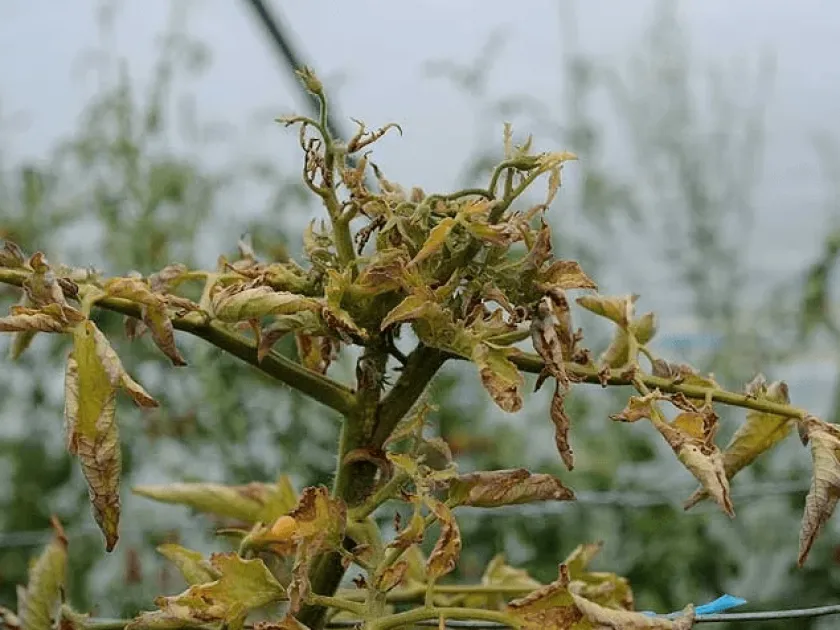
Description
Symptoms
A classic symptom of phytoplasmosis is severe plant deformation, often manifesting as "witches' brooms" — excessive branching of shoots combined with significantly shortened internodes.
Flowers frequently exhibit virescence, where petals turn green, or phyllody, where floral parts transform into leaf-like structures, leading to plant sterility and total loss of reproductive capability.
Leaf tissues often display chlorosis, turning yellow, or develop reddish-purple discoloration along the margins. Leaves become thickened, brittle, and may exhibit abnormal curling.
Infection disrupts the vascular system, resulting in stunted growth and overall plant weakness. The affected crops struggle to develop properly, often producing small, deformed, or malformed fruits.
Root crops, such as carrots, often show symptoms of "hairiness" or excessive growth of fine secondary roots on the main taproot, rendering the crop unmarketable and poor in quality.
Pathogen
Phytoplasmosis is caused by phytoplasmas, which are specialized pathogenic microorganisms belonging to the class Mollicutes. These organisms lack a cell wall, making them highly susceptible to environmental stress but exceptionally well-adapted for parasitism within plant tissues.
Phytoplasmas are restricted to the phloem tissue of plants, where they feed on the translocation stream of photosynthates. Their lack of a rigid cell wall allows them to deform and move through the sieve tube system of the host plant.
These pathogens cannot survive independently in the soil or in plant debris. They exist solely within the living cells of their host plant or within the body of specific insect vectors.
The lifecycle of phytoplasmas is inextricably linked to insects, such as leafhoppers, planthoppers, and aphids. An insect acquires the pathogen while feeding on an infected plant and remains a carrier for the rest of its life.
Once inside the insect, phytoplasmas multiply and migrate to the salivary glands, ensuring that every subsequent bite by the insect results in the transmission of the pathogen to a healthy plant.
Conditions for development
Warm and arid weather conditions are highly conducive to the spread of phytoplasmosis, as these conditions favor the rapid reproduction and high migration activity of insect vectors like leafhoppers.
The presence of reservoir hosts is a critical factor. Many perennial weeds, such as bindweed or sow thistle, serve as constant sources of phytoplasmas throughout the growing season.
A high density of insect vectors during the vegetative stage of crop development directly leads to major disease outbreaks. Vectors can move across large fields, rapidly infecting healthy plants.
Deviation from optimal planting times often results in young seedlings coinciding with the peak activity periods of insect vectors, leaving them highly vulnerable to infection.
Lack of crop rotation and the close proximity to infested perennial plantations (e.g., vineyards or orchards) facilitate the continuous circulation of the pathogen within the agricultural environment.
Why it matters
Phytoplasmosis causes significant economic losses, with yield reductions ranging from 20% to total crop failure. Infected plants often become non-productive and are outcompeted by healthy specimens.
The market quality of the produce is severely compromised: fruits lose flavor, have a shortened shelf life, and are unsuitable for processing, resulting in substantial financial loss for producers.
The difficulty of early-stage diagnosis is a major issue, as symptoms are often mistaken for nutrient deficiencies or viral diseases, preventing growers from taking timely intervention measures.
Since the infection is systemic and affects all parts of the plant, it can be passed through vegetative propagation material, leading to the long-term spread of the disease across new areas.
The wide host range of phytoplasmas — encompassing vegetables, fruits, and ornamentals — makes this pathogen a persistent threat across various agricultural and horticultural sectors.
Protection
The primary control strategy involves managing insect vectors using systemic insecticides during periods of peak leafhopper activity to minimize the risk of pathogen transmission.
Rigorous weed management in and around fields is essential, as weeds are the primary natural reservoirs for phytoplasmas, keeping the pathogen present even in the absence of crop plants.
Growers should prioritize the use of high-quality, certified, and pathogen-free planting material. In vegetative propagation, quarantine measures and thermotherapy are necessary to ensure plant health.
Implementing effective crop rotation and spatial isolation from perennial reservoirs can break the transmission cycle and significantly reduce the accumulation of the pathogen in the field.
Early identification and immediate rogueing (removal and destruction) of symptomatic plants are critical to localizing infection and preventing its spread across the entire plantation.
Discussion
No discussions yet — be the first.