
Canavirgella banfieldii
Canavirgella banfieldii
Description
Symptoms
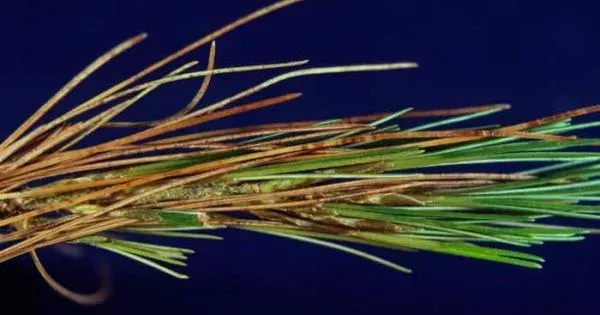
The primary symptom of this infection is the discoloration of needles on the previous year's growth. Needles turn from a healthy green to a pale yellow or straw-brown, often appearing abruptly.
The development of fruiting bodies, known as apothecia, is a key diagnostic feature. These appear as narrow, linear, dark structures along the midrib of the infected needles, eventually rupturing the epidermis.
Premature needle cast is a common consequence of a severe infection. This results in sparse crowns and exposed branches, significantly reducing the tree's overall canopy density.
Under magnification, black lines may be observed on the surface of the needles. These represent the boundaries of the fungal mycelium colonizing the host tissues.
Growth abnormalities or slight distortions in the shoots can sometimes be detected in young plants, particularly when the fungal infection is heavy and persistent.
Pathogen
The causal agent is the ascomycete fungus Canavirgella banfieldii. This pathogen is a specialized parasite that targets the needle tissues of specific conifer species.
The fungus completes its life cycle by producing ascospores. These spores serve as the primary means of dispersal, traveling through wind currents to infect nearby host trees.
It remains in a dormant state within the needles during unfavorable conditions, ready to reactivate when moisture and temperature levels become suitable.
The penetration of the fungal mycelium into the needles is a slow but steady process that eventually exhausts the plant's resources by interfering with its metabolic activities.
Its host specificity means that forest stands consisting of susceptible pine species are at a higher risk of experiencing outbreaks under favorable environmental conditions.
Conditions for development
High relative humidity and frequent precipitation are the main drivers of disease spread. Prolonged wet periods provide the necessary moisture for the germination of fungal spores.
Temperatures ranging from 15°C to 20°C are generally considered optimal for the rapid maturation of apothecia and the subsequent release of ascospores into the air.
Dense plantations with poor air circulation create a microclimate that retains moisture longer, significantly increasing the probability of cross-infection among trees.
Shaded lower branches that do not dry out quickly after rain are often the first to show signs of the infection, highlighting the importance of light and air access.
Stressed trees, whether due to nutrient deficiencies, soil compaction, or environmental factors, show lower resistance and are typically colonized by Canavirgella banfieldii more rapidly.
Why it matters
The major impact of this disease is the massive loss of foliage, which directly reduces the tree's photosynthetic capacity and weakens its vigor over time.
In forest nurseries, this fungus can be devastating, leading to significant seedling mortality and economic losses, which complicates reforestation efforts.
Trees that suffer from long-term infection become highly susceptible to secondary pests, including bark beetles and other pathogenic fungi that exploit weakened tissues.
The aesthetic decline of infected ornamental conifers is severe, rendering them unfit for landscape use and requiring costly removal or replacement.
Chronic infections can lead to a general decline in the health of forest ecosystems, potentially altering the composition and growth rates of the stand over many years.
Protection
Sanitation is the cornerstone of effective management. Pruning and destroying infected branches or collecting and burning fallen needles helps to reduce the primary inoculum load.
Improving the tree environment by thinning crowns to enhance airflow is a critical preventative measure that discourages fungal colonization and spread.
- Regular inspection of needles during the spring season;
- Removal of infected debris from the forest floor;
- Application of copper-based fungicides when necessary;
- Enhancement of soil health to boost tree immunity.
Fungicide applications, particularly during periods of spore release, can be effective in protecting young shoots but must be timed precisely with local weather forecasts.
Maintaining adequate spacing between newly planted trees is essential to prevent the future buildup of pathogen populations and to ensure healthy, vigorous growth.
Discussion
No discussions yet — be the first.