
Caloplaca maritima
Caloplaca maritima
Description
Symptoms
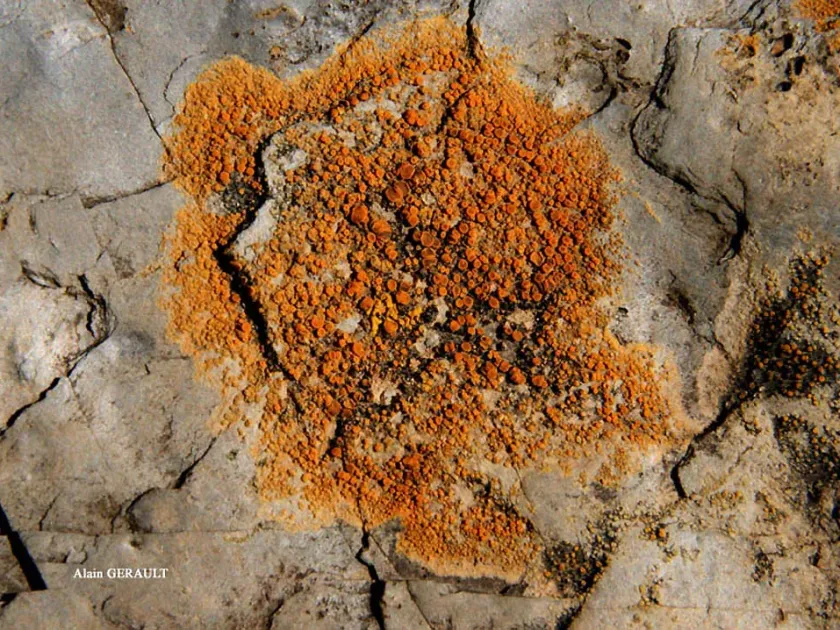
The most distinctive visual sign of Caloplaca maritima is the appearance of bright orange to yellow crusty patches covering the bark of trees or rocks.
The thallus is tightly attached to the substrate, forming a crust that cannot be easily scraped off without physical force or specialized tools.
Upon close inspection, small disc-like structures called apothecia, which are the fungal fruiting bodies, can be observed distributed across the lichen's surface.
The vibrant colors are due to the presence of secondary metabolites like parietin, which provide the lichen with natural protection against high solar radiation.
No lesions, rot, wilting, or structural damage to the underlying bark occur in the presence of this lichen, as it does not penetrate the cambium layer.
Pathogen
Caloplaca maritima is a species of crustose lichen belonging to the Teloschistaceae family. It is important to define it correctly: it is not a pathogen or a plant disease.
This organism is a symbiotic association between a fungus and an alga or cyanobacteria. It does not infect plants, nor does it derive nutrients from the host plant's internal tissues.
In botanical terms, it is classified as an epiphyte, using tree bark or rocky surfaces merely as an anchor point for its growth and survival.
It obtains all necessary nutrients from the atmosphere, rainfall, and dust particles, maintaining its independence from the life cycle of the tree it settles on.
The term "disease" is a common misconception; the lichen is simply utilizing the physical substrate provided by the tree's surface to thrive in its ecological niche.
Conditions for development
Caloplaca maritima prefers well-lit, open environments, making it a common sight on trees that are not obstructed by heavy canopy shade.
High humidity levels, common in coastal regions, are essential for this lichen, which is well-adapted to surviving in areas with salt-laden winds.
This species serves as a biological indicator of clean air. It is highly sensitive to atmospheric pollutants, especially sulfur dioxide, and thrives only in non-polluted areas.
Tree bark with a stable, slow-growing surface is the preferred host, allowing the slow-growing crustose lichen to expand over several years.
A moderate accumulation of mineral dust and particulates on the bark provides additional trace nutrients, which can support the lichen's long-term colonization.
Why it matters
There is no direct damage to the plant's health; however, heavy lichen colonization can present challenges for garden maintenance and observation.
The dense crusts can create micro-habitats that may shelter various insect pests, such as scales or mites, which may subsequently affect the plant's leaves or buds.
When the bark is entirely obscured by lichens, it becomes significantly harder for an agronomist to detect early signs of other, more dangerous plant pathogens.
While often overstated, the complete coverage of a trunk by thick lichen mats may slightly hinder the bark's ability to undergo typical gas exchange.
The primary concern for growers is aesthetic, as heavy lichen growth can sometimes be misinterpreted as a sign of neglect or poor tree health management.
Protection
No chemical fungicide intervention is required, as the lichen poses no threat to the vascular system of the trees or to the overall harvest quality.
Mechanical removal using a stiff-bristled brush or a blunt scraper during the plant's dormant season is the most effective and safe method for removal.
Proactive maintenance, such as whitewashing tree trunks with lime, creates an alkaline surface that prevents the lichen from successfully colonizing the bark.
Pruning trees to improve light penetration and air circulation within the crown is an excellent cultural practice to reduce humidity levels that favor lichen growth.
Monitoring is the best approach; focusing on general tree vigor and soil health ensures that the plant remains resilient, regardless of the presence of harmless epiphytes.
Discussion
No discussions yet — be the first.