
Calonectria leguminum
Calonectria leguminum
Description
Symptoms
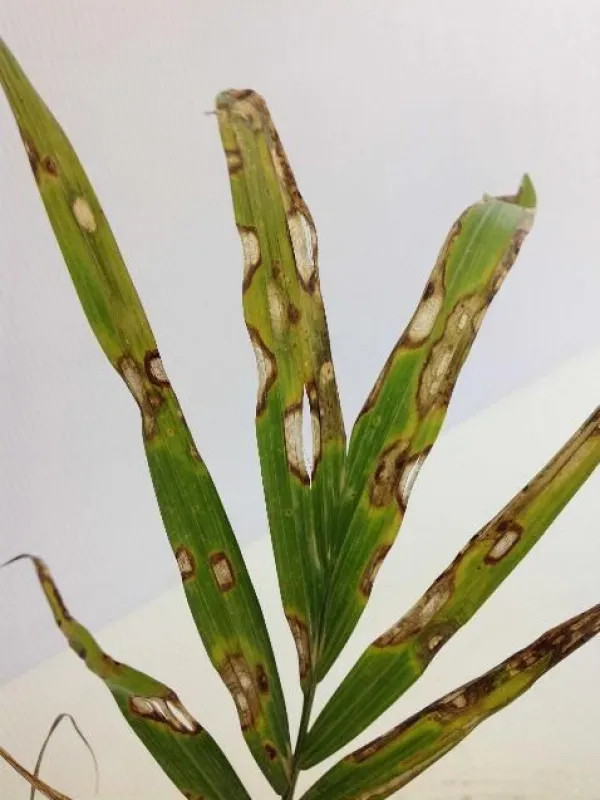
Initial symptoms of the infection include chlorotic spots on leaves and stems, which gradually darken to brown or reddish-brown. Often, a lighter-colored halo appears around the lesions, which is a diagnostic feature.
Damage to the root system is manifested by stunted growth, premature yellowing of lower leaves, and gradual wilting of the entire plant. Roots become dark, brittle, and subject to decay.
Stem lesions, particularly near the crown, often form deep ulcers. Under high humidity, these areas may be covered with white or pinkish sporulation, representing masses of the fungus's conidia.
Severe infections lead to pod deformation and the production of shriveled, low-vigor seeds that may carry the pathogen internally, further spreading the disease to new locations.
Mass outbreaks under high moisture conditions lead to premature defoliation and tissue necrosis, which can kill the crop before the pods reach maturity.
Pathogen
The causative agent of this disease is the ascomycete fungus Calonectria leguminum (anamorph stage: Cylindrocladium leguminum). This pathogen is known for its specialization and ability to persist in the soil for extended periods via mycelium or specialized resting structures.
The fungus affects a wide range of legumes, both agricultural and ornamental. The pathogen's mycelium penetrates host tissues, destroying cell walls and disrupting physiological processes, which severely weakens the plant.
Propagation occurs primarily through conidia, which are easily dispersed by rain splashes, wind, contaminated soil movement, or through agricultural equipment and infected seeds.
The biology of Calonectria leguminum is tied to its ability to saprotrophically exist on plant debris in the soil, making it highly resilient to adverse conditions and difficult to eradicate from agricultural ecosystems.
Diagnosis usually requires mycological laboratory analysis because external symptoms are often indistinguishable from those caused by other soil-borne pathogens or root rot complexes.
Conditions for development
High humidity and soil moisture are the critical factors for the development of Calonectria. Frequent rainfall, fog, and heavy dew create the perfect environment for spore germination and infection of plant tissues.
Optimal temperatures for mycelial growth and sporulation range between +18 and +25 degrees Celsius. Fluctuations in temperature combined with high humidity significantly enhance the fungus's activity.
Poor agricultural practices, such as excessive seeding density, create a stagnant microclimate in the lower canopy, increasing the likelihood of infection spread among neighboring plants.
Excessive soil nitrogen can promote the disease by stimulating tender vegetative growth, which is more susceptible to fungal penetration and colonization.
Continuous monocropping of legumes on the same field leads to a buildup of inoculum in the soil, making subsequent crops highly vulnerable to severe disease outbreaks.
Why it matters
The economic impact of Calonectria leguminum is significant, leading to substantial yield losses in leguminous crops. In severe cases, large portions of the crop can be completely lost.
Damaged root systems reduce the plant's ability to uptake water and nutrients, leaving the crop highly sensitive to drought and other environmental stresses.
Seed quality is severely compromised, rendering the harvest unsuitable for replanting and increasing the risk of distributing the pathogen to unaffected farming areas.
Economic losses include direct yield reduction as well as the high cost of implementing fungicide treatments and modifying crop rotation plans to sanitize infected fields.
The spread of the pathogen to neighboring fields often necessitates strict quarantine and phytosanitary measures, complicating general farming and trade operations.
Protection
Crop rotation is the most effective control measure; legumes should not return to the same field for at least 3–4 years, allowing the soil inoculum levels to naturally decline.
The use of certified, healthy, and fungicide-treated seeds is essential to prevent the introduction of primary infection into new fields.
Agricultural practices should include deep plowing to bury crop residues, which act as a reservoir for the pathogen during the off-season.
- Optimize plant density to improve air circulation and reduce canopy humidity.
- Implement balanced fertilization programs emphasizing potassium and phosphorus.
- Apply authorized fungicides at the first sign of symptoms during the growing season.
- Regularly monitor fields for phytosanitary status during critical growth stages.
If infection patches are discovered, affected plants should be removed and destroyed, and all machinery should be thoroughly disinfected to prevent mechanical spread.
Discussion
No discussions yet — be the first.