
Calocera viscosa
Calocera viscosa
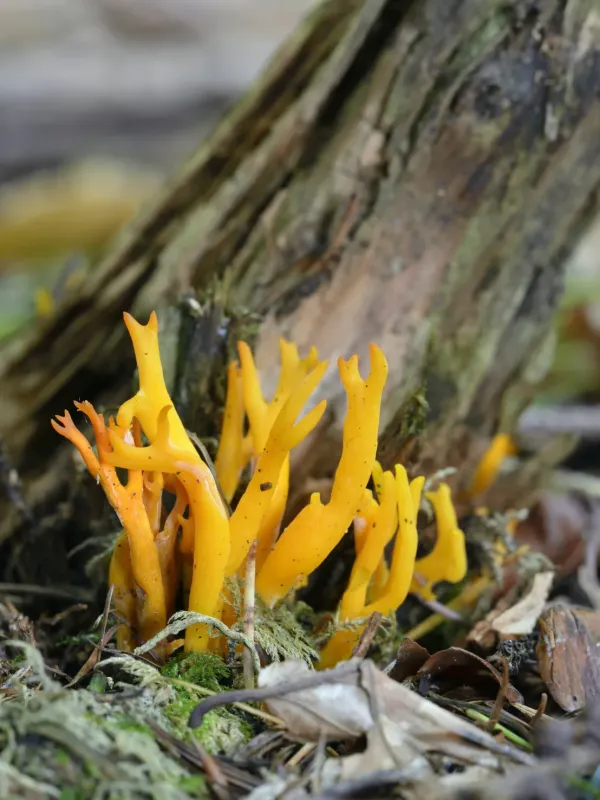
Description
Symptoms
The primary sign of its presence is the appearance of vibrant, coral-like fruiting bodies on stumps, logs, and decaying woody debris of coniferous species.
These fruiting bodies often grow in clusters. During dry spells, they may become tough or shrivel up, but they quickly regain their jelly-like consistency following rainfall.
The wood affected by the fungus eventually shows signs of brown rot, becoming brittle and prone to breaking into small, cuboidal blocks as the structural integrity of the cellulose is lost.
It is distinctively recognizable by its bright coloration and lack of a central stem, appearing as a network of tangled, fleshy branches protruding from the surface of the wood.
- Bright yellow-orange branching structures.
- Gelatinous or rubbery surface texture.
- Growth exclusively on coniferous wood.
- Signs of brown rot in the underlying substrate.
Pathogen
Calocera viscosa, commonly known as the yellow stagshorn, is a basidiomycete fungus in the Dacrymycetaceae family. It acts as a saprotroph, meaning it feeds on decaying organic matter rather than attacking living plants.
The fungus produces bright yellow or orange, branched fruiting bodies that are gelatinous in texture. These structures are designed to release spores into the environment to colonize new substrates.
As a wood-decay organism, it primarily breaks down cellulose and lignin in dead coniferous wood. This process contributes to the formation of brown rot, which is essential for nutrient cycling in forest ecosystems.
Unlike parasitic fungi, it lacks the specialized virulence factors required to breach the defenses of healthy, vigorous trees, limiting its role to that of a decomposer.
Its biological cycle is strictly dependent on the availability of damp, decaying wood, making it an indicator of forest health rather than a causative agent of tree disease.
Conditions for development
Calocera viscosa thrives in environments with high humidity and moderate temperatures. It is commonly found in damp, shaded forests where moisture levels remain consistent.
It prefers coniferous logs, stumps, and fallen branches. The fungus requires these moist, decaying substrates to successfully establish its mycelial network and produce fruiting bodies.
Optimal development occurs during periods of frequent rainfall, which keeps the wood substrate sufficiently hydrated to support the metabolic needs of the fungus.
The species is well-adapted to the microclimates of temperate forests, utilizing the protection of the forest canopy to maintain the damp conditions it favors.
While light levels do not directly influence its survival, shaded areas provide the necessary shelter to prevent the rapid evaporation of moisture, which is critical for its growth.
Why it matters
Calocera viscosa causes no economic damage to agricultural crops. It does not possess the capability to infect or harm healthy trees in managed forests or orchard environments.
In forestry, it is considered a beneficial decomposer. By breaking down dead wood, it releases trapped nutrients back into the soil, supporting the growth of surrounding vegetation.
There is no evidence to suggest that this fungus acts as a primary pathogen, and it does not facilitate the decline of otherwise healthy tree populations.
The fungus does not pose a threat to infrastructure or wooden structures unless they are already significantly decayed and in direct contact with damp soil.
Overall, the presence of yellow stagshorn is ecologically benign, serving as a sign of natural biological activity within decaying wood materials.
Protection
No control measures are necessary for Calocera viscosa, as it does not pose a risk to crops, living trees, or forest health.
If management of woody debris is required for aesthetic or forest safety reasons, standard forest hygiene practices such as removing stumps and cleaning up fallen branches are sufficient.
Maintaining high vitality and growth vigor in forest stands prevents the accumulation of dead wood that the fungus requires for its colonization.
Chemical control via fungicides is strictly discouraged, as it is both unnecessary and potentially harmful to the surrounding biodiversity of the forest ecosystem.
The best approach is to appreciate the role of the fungus as a natural recycler, as its existence is a normal component of a healthy, functioning ecosystem.
Discussion
No discussions yet — be the first.