
Calloria tremelloides
Calloria tremelloides
Description
Symptoms
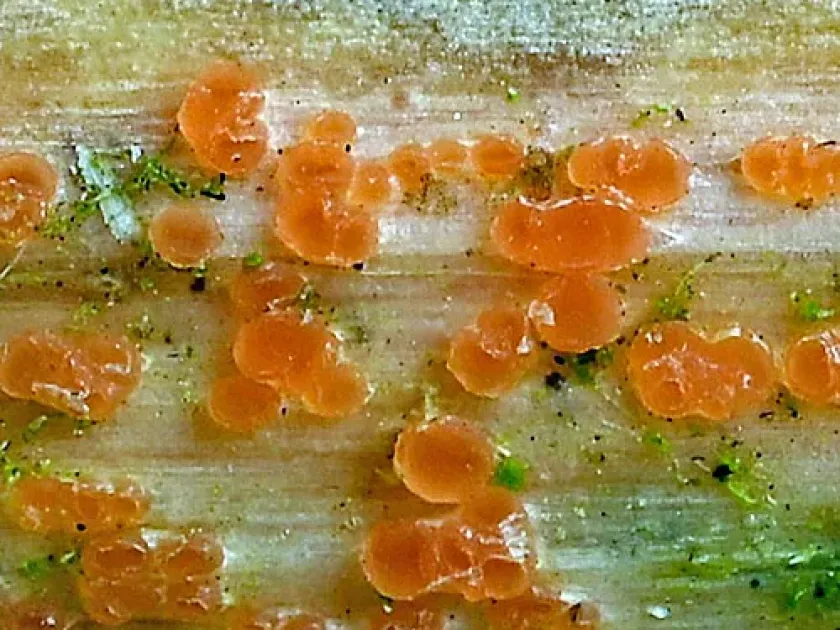
Calloria tremelloides manifests on the bark of infected trees as distinctive gelatinous or jelly-like fruiting bodies.
These structures typically appear in shades of bright orange to reddish-brown, making them easily noticeable against the tree bark during damp periods.
In dry weather, the fruiting bodies may shrink and become dense or nearly invisible, only to swell up again when moisture levels rise.
Infections are commonly found in areas where the bark has been compromised, such as cracks, frost damage, or improper pruning cuts.
Close inspection often reveals localized bark discoloration and necrosis surrounding the areas where the fungus is actively growing.
Pathogen
The causal agent is the fungus Calloria tremelloides, an ascomycete that often acts as a saprophyte or opportunistic pathogen on weakened trees.
The fungus propagates via spores that can be easily dispersed by wind, rain splashes, and insects to nearby susceptible hosts.
Fruiting bodies, known as apothecia, develop on the surface of the bark, providing the characteristic visual sign of the infection.
The biology of the fungus is highly dependent on environmental moisture, which is essential for the germination of spores and the development of the mycelium.
As a pathogen, it exploits pre-existing wounds to colonize the tree tissues, eventually leading to structural decay of the bark layer.
Conditions for development
High humidity, frequent rain, and prolonged foggy conditions create an optimal environment for the proliferation of this fungus.
Mechanical injuries such as broken branches, pruning wounds, or frost splits are the primary points of entry for the pathogen.
Dense, poorly managed orchards with inadequate airflow are prone to higher levels of infection due to the moisture-trapping microclimate.
Trees suffering from stress—whether due to nutrient deficiencies, poor soil, or weather extremes—are significantly more susceptible to colonization.
Neglecting basic orchard hygiene, such as leaving deadwood or infected pruning debris on site, facilitates the spread of fungal spores.
Why it matters
The primary damage is the degradation of the protective bark layer, which disrupts the transport of water and nutrients throughout the tree.
Continued fungal activity promotes the expansion of necrotic lesions, potentially leading to the death of major branches and yield reduction.
Affected tissues become highly vulnerable to secondary pests and more aggressive pathogens, accelerating the decline of the plant.
If left untreated, severe cases can lead to the gradual death of the entire tree as the bark integrity is systemically compromised.
In addition to physiological damage, infected trees often show reduced vigor and poor overall health, making them liabilities in a managed garden.
Protection
The primary control measure is rigorous sanitary pruning to remove all infected bark and branches, cutting back to healthy, non-discolored wood.
All surgical cuts on the tree must be treated with appropriate disinfectants and sealed with professional wound dressings to prevent reinfection.
Preventive trunk care, such as whitewashing, helps shield the bark from sunscald and frost cracks, significantly reducing entry points for fungi.
Improving tree vitality through balanced fertilization and proper irrigation helps the tree's natural defense systems remain active.
The use of copper-based fungicides can be effective in suppressing the development of the fungus and protecting healthy bark from spore infection.
Discussion
No discussions yet — be the first.