
Calicium viride
Calicium viride
Description
Symptoms
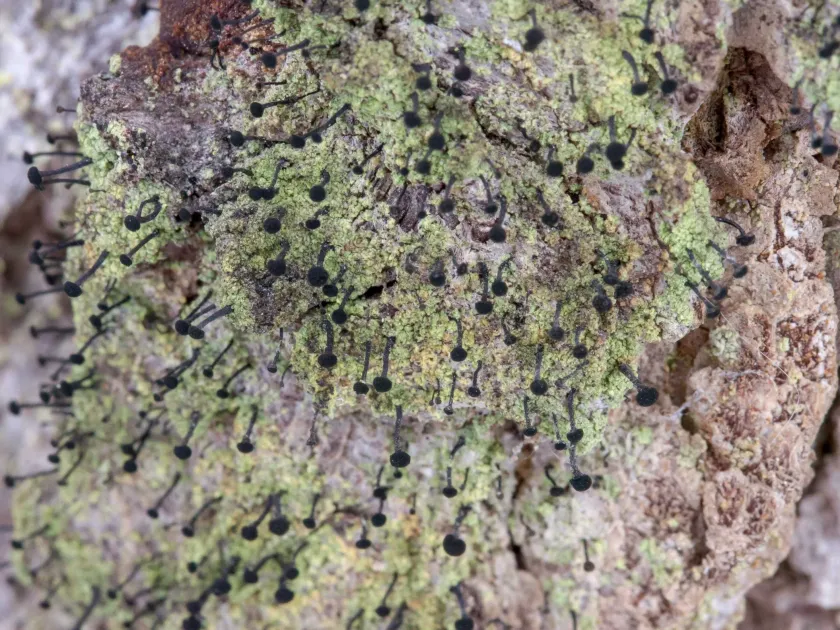
Calicium viride is a lichen species that appears as a greenish or yellowish-green growth on the bark of mature trees.
The visual signature of this organism includes small, black fruiting bodies called apothecia, which look like tiny pinheads on short stalks.
These structures typically develop in the crevices of bark where moisture and organic debris naturally accumulate.
The lichen's thallus becomes more vibrant and noticeable during damp or rainy weather when it absorbs moisture from the atmosphere.
It is most commonly identified on old-growth trees or in orchards where the bark has achieved a thick and stable structure.
Pathogen
It is important to clarify that Calicium viride is not a pathogen and does not cause plant diseases in the agronomic sense.
It is strictly an epiphytic organism that utilizes the tree bark merely as a physical substrate for anchoring its structure.
The lichen operates as a symbiotic organism between a fungus and green algae, obtaining nutrients from air and moisture rather than the tree.
Because it does not tap into the vascular system of the plant, it causes no direct physiological damage to the host.
In biological terms, its presence is a sign of ecological continuity rather than an infectious disease cycle.
Conditions for development
Calicium viride requires specific environmental conditions, primarily high humidity and stable, long-term exposure to moisture.
It thrives in shaded, cool environments where the bark remains damp for extended periods after rain or mist.
The lichen is known to be an indicator of clean air quality, as it is highly sensitive to atmospheric pollutants such as sulfur dioxide.
It prefers the deep, moisture-retaining furrows of bark found on older, mature trees rather than smooth or young bark.
Consistent environmental conditions and minimal disturbance are essential for the long-term establishment of these lichen colonies.
Why it matters
This organism causes no direct damage to healthy trees, as it does not consume tree tissues or interfere with nutrient transport.
Potential indirect issues may arise if the lichen cover becomes excessive, potentially retaining moisture that could favor other pathogenic fungi.
While some growers worry about bark health, the lichen itself is essentially harmless and is merely a resident on the surface.
The presence of Calicium viride is often a marker of the tree's advanced age, which naturally makes the tree more susceptible to other stressors.
It should not be considered a primary threat to crop production or the overall vitality of agricultural plantings.
Protection
No specific chemical control is needed for Calicium viride, as it is not a disease-causing agent or a parasitic organism.
If management is desired for aesthetic reasons, mechanical cleaning of the bark during the dormant season is the most effective approach.
Improving air circulation through proper pruning of the tree canopy can reduce the localized humidity that the lichen requires.
Applying a lime wash to the trunks of fruit trees in early spring can discourage the colonization of lichens on the bark.
Focusing on balanced nutrition and proper orchard maintenance will promote overall tree vigor, which is the best defense against environmental stressors.
Discussion
No discussions yet — be the first.