
Walnut bacterial blight
Brenneria nigrifluens
Description
Symptoms
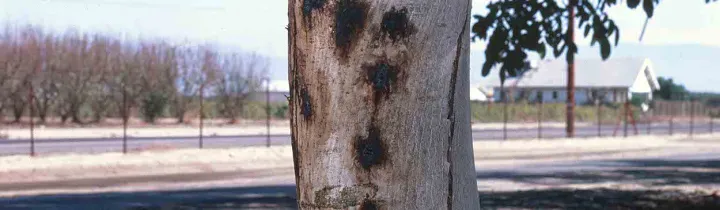
The most prominent sign is the development of dark, sunken cankers on the trunks and major limbs. These lesions are often accompanied by the exudation of a black, gummy liquid during the growing season.
When the black exudate dries, it creates dark, crusty patches on the bark surface. Removing these patches usually reveals necrotic, soft, and discolored tissues underneath that may emit a foul odor.
As the necrosis progresses, the bark may crack and peel, exposing the underlying wood. If the cankers girdle the trunk or branches, the entire section distal to the infection will eventually die.
Foliar symptoms include chlorosis and premature senescence of leaves on affected branches. This occurs because the flow of nutrients is interrupted by the necrotic bark tissues at the base of the branch.
In advanced cases, dieback of the canopy becomes evident. The contrast between healthy and infected tissue is usually sharp, marking the boundary where the bacterium is actively colonizing the host.
Pathogen
The causal agent of this disease is Brenneria nigrifluens (formerly known as Erwinia nigrifluens), a Gram-negative bacterium. It is a highly specialized plant pathogen that primarily affects the bark tissues of walnut trees.
This bacterium belongs to the Enterobacteriaceae family and is known for its ability to persist in infected wood, living cells, and even in plant debris within the orchard environment.
The pathogen utilizes enzymes to degrade cell walls, allowing it to colonize the cambium and phloem layers. This process eventually leads to the formation of characteristic bark necrosis and canker lesions.
The disease is systemic in nature, and the bacterium can remain latent in the tree for some time before visible symptoms emerge, making it difficult to detect during the early stages of the infection.
Dissemination occurs through splashing rain, wind-blown droplets, and contaminated pruning tools, which makes orchard hygiene the primary factor in managing the disease spread.
Conditions for development
The development of Brenneria nigrifluens is highly favored by cool, wet weather conditions. Rain splashes play a critical role in spreading the bacteria to healthy parts of the tree and to adjacent trees.
Bark wounds caused by winter cold injury or frost cracks act as primary infection courts. These weakened areas provide the perfect environment for the bacteria to enter and establish a colony.
Poor orchard ventilation and high tree density create a microclimate with high humidity, which is ideal for the survival and multiplication of the pathogen on the bark surface.
Trees that are under stress—whether from poor irrigation, nutrient deficiencies, or soil compaction—show reduced resistance and are more susceptible to colonization compared to healthy, vigorous trees.
Insect activity can also facilitate the spread, as boring or feeding insects create deep wounds that bypass the tree's natural epidermal defenses, allowing direct bacterial entry.
Why it matters
The primary harm is the structural and physiological damage to the tree, leading to severe branch dieback. This loss of canopy directly correlates to a significant reduction in annual nut yields.
Severe infections can girdle the main trunk, which inevitably results in the death of the entire tree. For a long-lived crop like walnut, this represents a substantial long-term economic loss.
The wood quality of infected trees is compromised, as the necrosis weakens the timber, making it more prone to breakage during high winds or heavy nut loads.
Orchard profitability is negatively impacted by the constant need for labor-intensive sanitation, such as pruning, disinfecting tools, and potentially removing dead trees entirely.
If left unchecked, the disease can spread throughout an entire plantation, turning a productive orchard into a collection of dying trees, requiring significant investment to replant and restore.
Protection
The most effective management strategy is rigorous sanitation. All infected branches must be pruned well below the visible canker, and the removed wood should be destroyed by burning immediately.
Tool hygiene is crucial. Pruning saws and shears must be disinfected after every single cut using alcohol or quaternary ammonium compounds to prevent transferring the bacteria between trees.
Copper-based bactericides applied during the dormant season (late autumn or early spring) can help reduce the bacterial population on the bark and limit the potential for new infections.
Protecting wounds with appropriate wound dressings or sealants after pruning or storm damage can block entry points and reduce the likelihood of successful bacterial colonization.
Maintaining optimal tree health through balanced fertilization and proper irrigation helps bolster the tree's natural defenses, making it more resilient against Brenneria nigrifluens attacks.
Discussion
No discussions yet — be the first.