
Botryosporium blight
Botryosporium pulchrum
Description
Symptoms
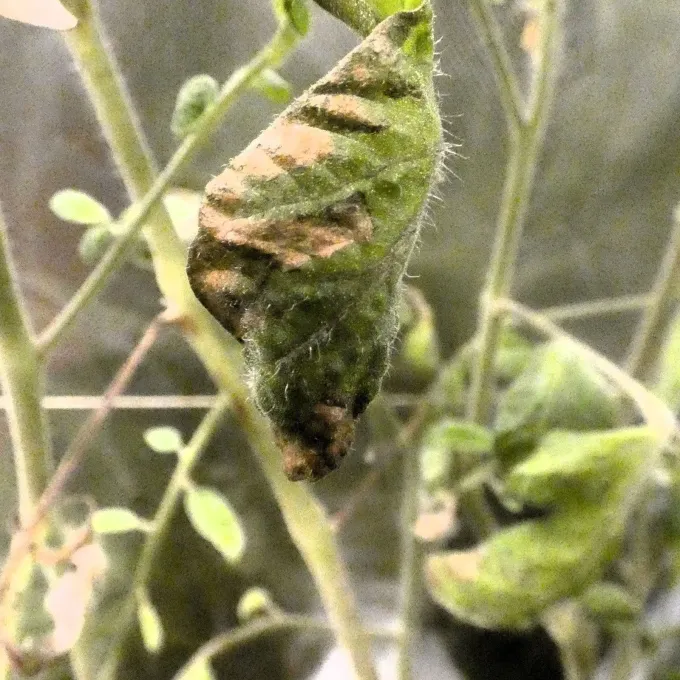
The primary symptom is the development of an abundant, white to greyish, downy or cobweb-like mycelial growth on affected leaves, stems, or inflorescences.
Under magnification, the characteristic branched, tree-like conidiophores are clearly visible, covering the surface of the infected tissue like a dense forest of tiny structures.
Tissue under the fungal colony becomes discolored, soft, and eventually necrotic. In severe cases, the infected area emits a musty odor typical of many fungal rots.
Symptoms often start on senescing or damaged plant parts, such as wounded stems or fading flower petals, before spreading to healthy tissues.
The rapid appearance of this fluffy mold in humid conditions is the diagnostic hallmark of Botryosporium infection in agricultural settings.
Pathogen
The causal agent of this disease is the imperfect fungus Botryosporium pulchrum, which belongs to the order Hyphomycetes. It acts primarily as a saprotroph but can behave as a weak parasite on weakened plant tissues.
The fungus produces distinctive conidiophores that branch in a tree-like pattern, which is the most reliable feature for laboratory identification. These structures support clusters of minute, hyaline conidia.
The mycelium colonizes the surface of plant organs and gradually penetrates the epidermis. It thrives on necrotic or decaying organic matter, making it a common inhabitant of garden debris.
Spores are dispersed primarily by wind and air currents, allowing the pathogen to spread quickly within greenhouses or dense crop stands.
The biological cycle is driven by moisture availability, which dictates the intensity of sporulation and the subsequent colonization of the host plant.
Conditions for development
The disease flourishes under conditions of high relative humidity, typically exceeding 80–85%. Moist environments are essential for both spore germination and hyphal extension.
Optimal temperatures for the growth of Botryosporium pulchrum range from +20°C to +25°C. Rapid proliferation occurs when these temperatures coincide with high moisture.
Poor ventilation in greenhouse environments is a major contributing factor. Stagnant air leads to micro-climates that are perfectly suited for fungal colonization.
Free water on leaf surfaces, caused by overhead irrigation or condensation, significantly boosts the efficiency of spore penetration into the plant epidermis.
Plants under physiological stress, such as those damaged by insects or improper fertilization, are significantly more vulnerable to infection than healthy specimens.
Why it matters
The damage caused by Botryosporium blight includes the destruction of flowers and fruits, leading to direct yield loss and reduced commercial value of the crop.
Premature leaf senescence reduces the overall photosynthetic capacity of the plant, which results in stunted growth and weakened resilience to other stressors.
In post-harvest scenarios, the fungus can rapidly spread among stored produce, causing significant decay and rendering the harvest unmarketable.
In seedling production, the disease can wipe out entire trays of young plants, making it a serious concern for greenhouse nurseries.
Although it is often considered a secondary pathogen, its ability to thrive in high-density environments makes it a persistent nuisance in modern intensive farming.
Protection
Management focuses on sanitation and environmental control. Keeping humidity levels low through proper ventilation is the most effective way to inhibit fungal growth.
Removing plant debris and infected tissues immediately prevents the build-up of inoculum. Maintaining a clean growing environment is crucial for disease suppression.
Switching from overhead irrigation to drip irrigation reduces leaf wetness and lowers the risk of spore germination and tissue penetration.
Fungicide applications may be necessary when environmental conditions favor disease outbreaks, focusing on products effective against Hyphomycetes.
- Improve greenhouse ventilation systems
- Increase spacing between plants to enhance air circulation
- Adopt strict sanitation of tools and benches
- Monitor crops frequently for early signs of mold
- Maintain balanced plant nutrition to avoid succulent tissue growth
Discussion
No discussions yet — be the first.