
Botryosporium blight
Botryosporium longibrachiatum
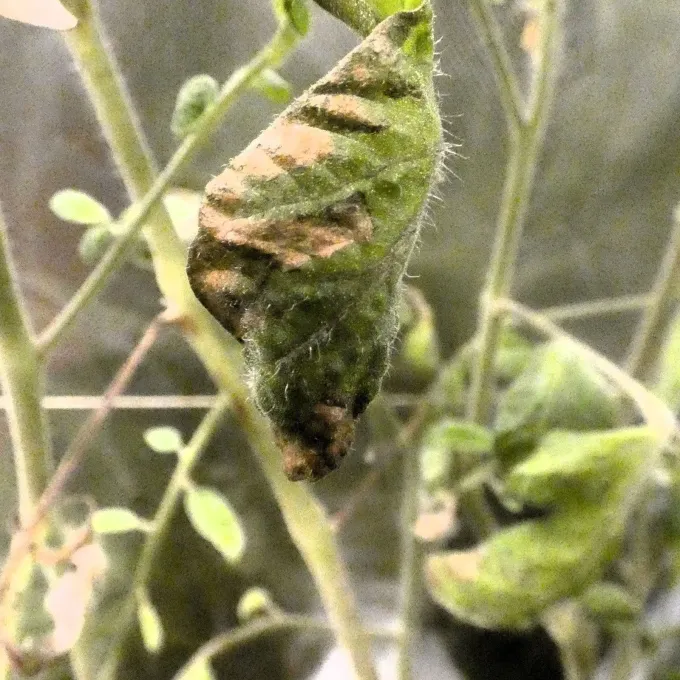
Description
Symptoms
The primary symptom is the appearance of a loose, white, cotton-like mycelial growth on the surface of leaves, stems, or fruit. This mass of conidiophores is easily visible to the naked eye under humid conditions.
Initial signs often appear on necrotic or damaged areas, such as pruning wounds, petal drops, or bruised skin on fruit. From these points, the infection spreads to adjacent healthy tissues.
As the infection progresses, affected tissues turn soft and start to decay rapidly. On tomato or pepper fruits, the blight results in a watery rot that is quickly covered by the characteristic white fungal growth.
Leaves may exhibit irregular, pale brown patches that serve as sites for spore production. These spots weaken the leaf, leading to wilting, yellowing, and eventually tissue senescence.
Under a microscope, the branching pattern of the conidiophores is a diagnostic feature. It is essential to distinguish this from Botrytis cinerea (gray mold), as their management strategies can differ.
Pathogen
The causal agent of this disease is the imperfect fungus Botryosporium longibrachiatum (phylum Ascomycota). It is primarily known as a pathogen that thrives in high-humidity environments, such as commercial greenhouses.
The fungus produces distinctive, long, and profusely branched conidiophores. These structures give the affected plant parts a characteristic fluffy, white appearance, often mistaken for other types of fungal mold.
Biological activity of the pathogen is closely tied to decaying plant matter, which serves as a reservoir for the fungus. It can survive on dead leaves, stems, and debris until conditions become suitable for infection.
Dissemination occurs via airborne conidia. These spores are highly mobile and can travel through greenhouse ventilation systems, landing on susceptible host tissues to initiate new infection cycles.
The fungus acts as a facultative parasite, meaning it can rapidly shift from a saprophytic lifestyle on dead tissue to a pathogenic phase when it encounters weakened or senescent plant parts.
Conditions for development
High relative humidity, typically above 85-90%, is the most critical factor for the development of Botryosporium blight. The pathogen is highly dependent on moisture to germinate and establish infection.
The optimal temperature range for the pathogen is between 18°C and 24°C (64°F - 75°F). This temperature range is frequently maintained in greenhouse settings, making these facilities highly prone to outbreaks.
Poor ventilation leads to stagnant air and high moisture levels around the foliage. This provides the perfect environment for the fungus to settle and begin its colonization of the plant tissue.
Condensation caused by rapid temperature drops during the night provides essential surface moisture on leaves and fruit. This layer of water is critical for the activation and penetration of fungal spores.
Plants under stress from poor lighting, nutrient deficiencies, or overcrowding are significantly more susceptible to infection. Stressed tissue allows the fungus to gain an initial foothold more easily.
Why it matters
The most significant economic damage is the loss of crop quality. Infected fruits become unsalable due to rapid softening and decay, resulting in high cull rates for commercial growers.
Yield reduction occurs as the disease kills vegetative organs and disrupts photosynthesis. When the infection reaches stems or main branches, the health of the entire plant may be compromised.
The fungus can spread rapidly throughout a greenhouse if left unchecked. A single outbreak on one plant can quickly lead to an epidemic due to the large number of spores produced by the fungus.
Secondary infections are common, as the damage caused by the fungus provides entry points for various bacterial and other fungal pathogens, further complicating the plant's health recovery.
Post-harvest losses are also possible if the infection is present on the fruit during shipping, as the decay process accelerates in storage conditions.
Protection
Effective management begins with strict environmental control. Maintaining humidity below 80% and ensuring constant airflow are the most efficient ways to suppress the development of the blight.
Sanitation is paramount in the control strategy. All infected debris must be removed and destroyed to reduce the primary inoculum load in the greenhouse environment.
Cultural practices such as proper pruning, thinning, and maintaining adequate spacing between plants are essential to increase air circulation and reduce micro-humidity around the plants.
Biological control agents, particularly strains of Bacillus subtilis, have shown potential in inhibiting the growth of the fungus when applied as a preventative treatment.
- Maintain low humidity levels using heating and ventilation.
- Implement strict greenhouse sanitation protocols.
- Avoid overcrowding to improve airflow.
- Remove and destroy infected plant parts immediately.
- Use fungicides registered for the crop when infection risk is high.
Discussion
No discussions yet — be the first.