
Black root rot
Berkeleyomyces rouxiae
Description
Symptoms
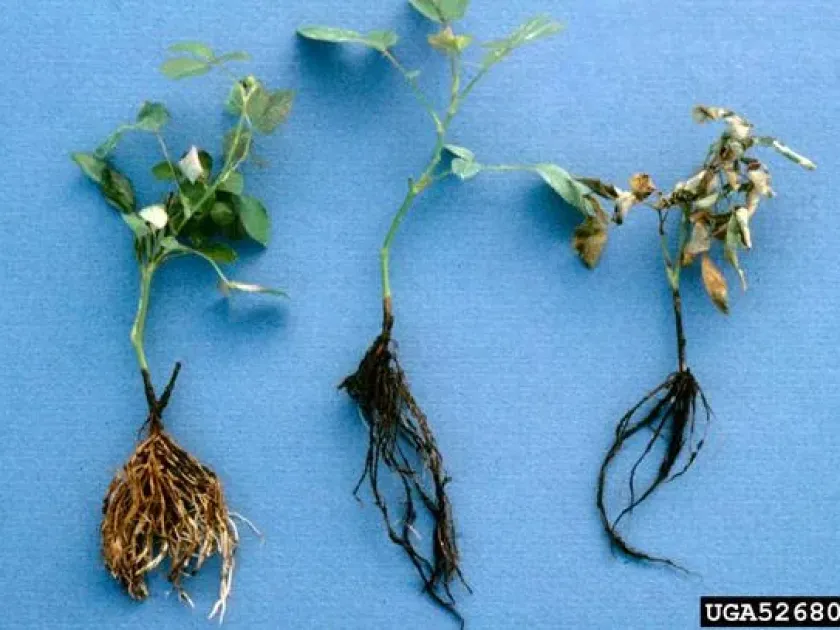
Symptoms of black root rot often start with wilting during periods of high transpiration, followed by chlorosis (yellowing) of the leaves, starting from the lower parts of the plant. Infected plants usually exhibit significant stunting and reduced overall vigor.
When the root system is examined, characteristic dark brown to coal-black necrotic lesions are visible on the roots. These lesions may coalesce, eventually covering the entire root system and resulting in total decay and the death of lateral rootlets.
In young seedlings, the pathogen causes a condition known as "black stem rot" or damping-off, where the base of the stem becomes thin, blackened, and constricted, leading to the collapse of the stem at the soil line.
The decay often destroys the main root system, leaving only a blackened, brittle stub. If the plant is pulled from the soil, it may break off, leaving the decayed roots behind, which further illustrates the destructive nature of the infection.
Under conditions of high humidity, a sparse grayish fungal growth might appear on the infected root surface. However, this is not always present, making the darkening and rotting of the roots the most reliable visual indicator of the disease's presence.
Pathogen
The causative agent of black root rot is the soil-borne fungus Berkeleyomyces rouxiae, formerly classified as Thielaviopsis basicola. It is a highly specialized pathogen that persists in the soil through the production of durable chlamydospores, allowing it to survive for years without a host plant.
This fungus has a wide host range, attacking numerous vegetable, ornamental, and agricultural crops, including tobacco, tomatoes, cucumbers, beans, and various greenhouse flowers like poinsettia. Its ability to infect multiple species makes it a significant threat to diverse production systems.
The fungus invades the root system by penetrating the epidermis, specifically targeting the cortical tissue. Once inside, the fungal mycelium colonizes the vascular system and cortical cells, causing rapid decay and cell death, which severely disrupts the plant's ability to uptake water and nutrients.
The life cycle involves the production of both endoconidia and thick-walled chlamydospores. Endoconidia facilitate rapid spread through irrigation water, while chlamydospores are the primary resting structures that enable the fungus to persist in agricultural soils indefinitely.
Diagnosis of the pathogen is often confirmed via microscopic examination of root tissue, where the distinct dark-colored spores of the fungus can be identified. Due to its persistence, isolating and confirming the pathogen is essential for effective farm management planning.
Conditions for development
The optimal environment for Berkeleyomyces rouxiae includes cool soil temperatures (typically 15–22 °C or 59–72 °F) and high soil moisture levels. Consequently, the disease is most prevalent during damp spring or autumn weather or under poor irrigation management.
Soil pH plays a critical role in the pathogen's activity, with infection rates being much higher in soils with a pH between 5.0 and 7.0. The fungus tends to be less competitive and damaging in highly alkaline soils.
Dissemination occurs primarily through contaminated soil, infested irrigation water, infected transplants, and the movement of equipment or tools that haven't been sanitized. In greenhouse operations, the reuse of contaminated growing media is a frequent cause of outbreaks.
Poor soil aeration and compaction exacerbate the problem, as these conditions stress the plant and favor fungal growth. Excessive watering that creates anaerobic conditions around the roots is a major driver of severe infection outbreaks.
The pathogen's ability to survive in a dormant state for long periods means that once a field or greenhouse bench is infested, it remains a threat to future plantings unless thorough sanitation and soil sterilization are performed.
Why it matters
The economic impact of black root rot is substantial, often resulting in significant crop losses ranging from minor reductions in growth to the total death of entire batches of plants. This is particularly devastating in the greenhouse industry.
Infected fields suffer from long-term loss of productivity, as the persistent chlamydospores limit the options for crop rotation. Growers are forced to avoid sensitive crops for years, which disrupts farm management plans and reduces agricultural land efficiency.
The quality of the produce is severely compromised, rendering it unfit for market. Even when plants survive initial infection, their low vigor makes them more susceptible to other pests and diseases, increasing the need for additional chemical inputs.
In floriculture and nursery operations, the pathogen necessitates the destruction of entire plant batches, resulting in direct financial losses. Furthermore, the costs of sanitizing and replacing growing media are significant burdens for producers.
The harm extends to the potential for environmental spread, as the fungus can be easily moved to new locations via runoff water or contaminated equipment, broadening the area of infestation and complicating disease management on a larger scale.
Protection
Integrated disease management starts with rigorous crop rotation, avoiding sensitive species on infested ground for at least 3 to 4 years. Planting resistant varieties or using grafted plants can significantly reduce infection risk.
Greenhouse sanitation is paramount; steam sterilization of growing media and disinfection of benches, tools, and equipment effectively eliminate the fungus. Always use high-quality, certified disease-free seedlings to avoid introducing the pathogen.
Adjusting soil pH to 7.0 or above, where feasible, can help suppress the activity of the fungus, as it thrives in slightly acidic environments. This is a common strategy in tobacco production and can be applied in other suitable agricultural settings.
Biocontrol agents, such as beneficial fungi in the Trichoderma genus, are used to compete with the pathogen and provide a protective barrier for the roots. Incorporating these into the growing media before planting can reduce disease incidence.
Improved cultural practices, such as proper irrigation scheduling and ensuring good soil drainage, are essential for prevention. If disease is detected, prompt rogueing of infected plants, including the surrounding soil, is necessary to limit the spread of the pathogen.
Discussion
No discussions yet — be the first.