
Black root rot
Berkeleyomyces
Description
Symptoms
Symptoms often start with stunted growth and leaf chlorosis, as the compromised root system can no longer supply sufficient nutrients and water to the plant canopy.
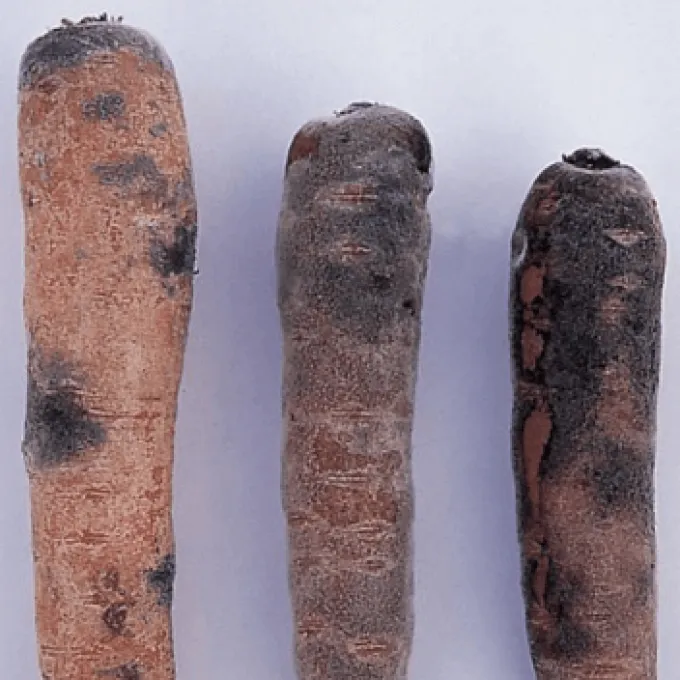
The most diagnostic sign is the presence of black, necrotic lesions on the roots. These darkened areas are characterized by softened tissues, leading to eventual root system decay.
In cases of severe infestation, the roots may appear entirely blackened and disintegrate into a pulpy consistency. This destruction of the roots often leads to sudden plant wilting.
For seedlings, the disease frequently manifests as "black root rot" or "black shank," where the base of the stem turns black and rots, causing the seedling to collapse and die.
Microscopic examination of the affected root tissues typically reveals dark, chain-like spores produced by the fungus, which serve as a clear indicator of the pathogen's presence.
Pathogen
The causal agent of black root rot is the soil-borne fungus Berkeleyomyces basicola (formerly known as Thielaviopsis basicola). It is a persistent pathogen that survives in soil for extended periods.
The fungus produces two types of spores: endoconidia, which facilitate rapid spread, and thick-walled chlamydospores, which allow the fungus to survive in the soil for years even without a host.
Infection typically occurs through roots or minor abrasions. Once established, the pathogen colonizes the cortical tissue of the roots, effectively disrupting the plant's vascular system.
The broad host range of this pathogen includes many economically significant crops, such as tobacco, beans, peppers, and various ornamental species, making it a major agricultural concern.
The biological cycle of this fungus is closely linked to soil health, where it can persist in dormant states until environmental conditions favor active infection and spread.
Conditions for development
Black root rot thrives in cool to moderate soil temperatures, generally between 15°C and 25°C, making it particularly problematic during the early stages of the growing season.
Soil pH is a critical factor; the pathogen is most active in neutral to alkaline soils (pH above 6.0), while acidic soil environments can sometimes inhibit the development of the disease.
Excessive soil moisture, poor drainage, and soil compaction are the primary environmental drivers that facilitate the spread of spores and the infection of healthy roots.
Continuous cropping of susceptible species without adequate rotation significantly increases the inoculum density in the soil, leading to severe outbreaks in subsequent years.
Over-irrigation or heavy rainfall events that keep the root zone saturated for prolonged periods provide the optimal conditions for the fungus to multiply and spread.
Why it matters
The economic impact of Berkeleyomyces is substantial, as it leads to severe yield losses, delayed plant development, and increased input costs for farm management.
By damaging the root system, the pathogen significantly reduces the plant's tolerance to environmental stresses, such as drought or heat, often leading to total crop failure.
Infected crops often exhibit reduced fruit size and lower quality, impacting the marketability and value of the agricultural production significantly.
The ability of the fungus to survive in soil for long periods makes it difficult to manage once a field is contaminated, necessitating long-term adjustments to crop management.
Secondary infections often take advantage of plants weakened by black root rot, compounding the damage and complicating efforts to diagnose and treat the initial infection.
Protection
Management strategies focus on a combination of cultural practices, such as long crop rotations, to reduce the amount of inoculum present in the field soil.
Maintaining an optimal soil pH (slightly acidic, if possible) can help create conditions that are less conducive to the growth and spread of the fungus.
Improving soil aeration and drainage, alongside the use of clean, disease-free seed and transplants, are essential preventative measures to avoid introducing the pathogen.
- Utilizing resistant or tolerant crop varieties.
- Sanitizing farm equipment to prevent movement of contaminated soil.
- Managing irrigation to avoid saturation of the root zone.
- Applying biological control agents, such as Trichoderma species.
Fungicidal treatments may be used in high-value crops to provide protection, though their effectiveness is largely dependent on proper application timing and soil conditions.
Discussion
No discussions yet — be the first.