
Dark honey fungus
Armillaria obscura
Description
Symptoms
Initial symptoms often include chlorosis, foliage thinning, and a significant reduction in the annual growth of branches and terminal shoots.
Under the bark of the root collar, one can observe white, fan-shaped mycelial mats, which often emit a distinct, pleasant mushroom-like aroma.
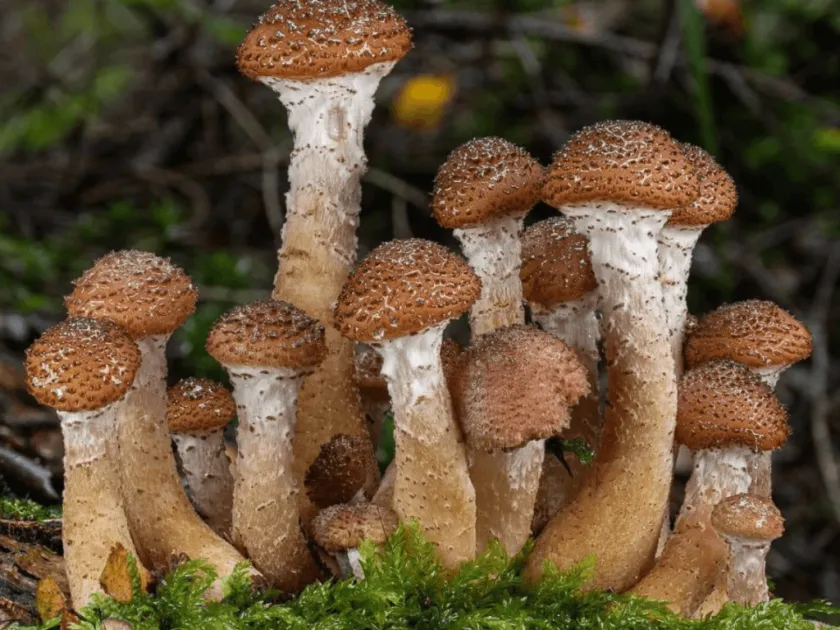
During the autumn, clusters of dark-scaled mushrooms appear at the base of the infected tree or on nearby stumps, signaling the reproductive phase.
When examining cross-sections of the wood, characteristic black, hair-like lines called zone lines appear, marking the boundaries of fungal decay.
Advanced stages of the disease lead to the softening and discoloration of the wood, resulting in tree instability and eventual windthrow.
Pathogen
The causative agent of this disease is the fungus Armillaria obscura (often associated with Armillaria ostoyae), a basidiomycete that acts as a serious forest pathogen.
This fungus primarily infects the root system and the root collar of living trees, leading to the development of extensive white rot in the wood.
The pathogen spreads through the soil via rhizomorphs—root-like fungal structures that can actively seek out and penetrate the bark of susceptible hosts.
In addition to root spread, the fungus produces basidiospores that are dispersed by wind, allowing it to colonize stumps and deadwood over wide areas.
The ability of this fungus to persist as a saprotroph in woody debris makes it a long-term threat to forest stability and health.
Conditions for development
Moist soil conditions are highly favorable for the development of rhizomorphs, significantly increasing the rate of infection in forest stands.
Trees that are stressed by prolonged drought, insect infestations, or physical injury are far more susceptible to infection by the fungus.
The presence of large, decaying stumps provides a major nutritional base for the fungus, allowing it to build up a high level of inoculum.
Optimal growth temperatures for the mycelium range from 15 to 25 degrees Celsius, though the fungus demonstrates significant environmental resilience.
Improper soil management and poor drainage in plantations can exacerbate the disease, creating an environment where the fungus thrives unchecked.
Why it matters
The dark honey fungus is a major cause of forest decline worldwide, affecting both coniferous and broadleaf species in diverse ecosystems.
Infection leads to the degradation of timber quality, making the affected wood commercially useless due to the progressing white rot decay.
The death of trees within a stand results in gaps that disrupt the forest canopy, leading to economic losses and altered local microclimates.
Forest plantations are particularly vulnerable, as the pathogen can cause mass mortality in young stands, requiring costly replanting efforts.
Once established in a site, the fungus remains in the soil for years, severely limiting the choice of tree species for future reforestation efforts.
Protection
The most effective strategy involves the prompt removal of infected trees and the extraction of stumps to eliminate the primary sources of inoculum.
Promoting mixed-species forest stands is a proven cultural practice that helps reduce the speed and intensity of root rot spread across the site.
Biological control using antagonistic fungi, such as species of Trichoderma, can be applied to protect root systems in high-risk nurseries.
Site sanitation and the prevention of physical damage to healthy trees during logging operations are critical to minimizing new infection pathways.
Regular forest health monitoring and early detection of infection spots are essential to preventing the disease from spreading to large areas.
Discussion
No discussions yet — be the first.