
Armillaria luteobubalina
Armillaria luteobubalina
Description
Symptoms
Initial symptoms include reduced vigor, chlorotic (yellowing) foliage, and premature leaf drop across the entire canopy of the infected tree.
Under the bark at the base of the stem, one can find white, fan-shaped mats of mycelium, which often emit a distinctively sweet or mushroom-like odor.
Dark, thread-like rhizomorphs are often found attached to the outer surface of infected roots when they are exposed by careful excavation.
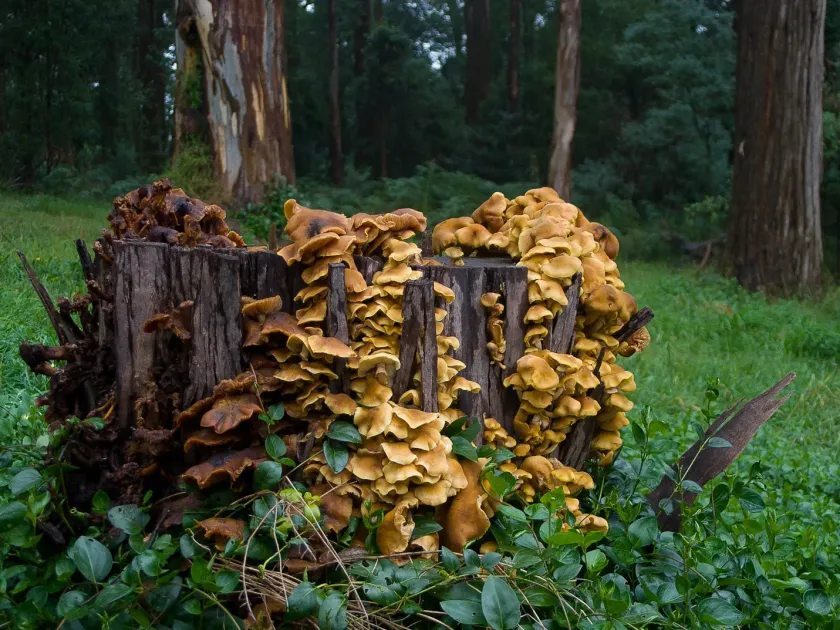
Clusters of honey-colored mushrooms appear at the base of the trunk in late summer or autumn, especially after significant rainfall events.
The affected wood in the root and collar zone becomes soft and white, showing a spongy consistency that destroys the tree's structural integrity.
Pathogen
The disease is caused by Armillaria luteobubalina, a highly aggressive fungal pathogen belonging to the honey fungus group.
This pathogen spreads primarily through rhizomorphs—black, cord-like structures that grow through the soil to infect the root systems of healthy hosts.
The fungus attacks the roots and the root collar of trees, colonizing the cambium layer and effectively severing the water and nutrient supply to the crown.
It acts as a primary parasite, capable of killing vigorous, healthy trees, and can survive for many years as a saprophyte in stumps and dead organic matter.
The pathology is characterized as a severe root and butt rot, making it one of the most critical threats to biodiversity in forests and orchards.
Conditions for development
The fungus thrives in environments with high soil moisture and poor drainage, which facilitate the rapid growth of rhizomorphs through the soil profile.
Optimal temperatures for the development of Armillaria species generally range between 15°C and 25°C, corresponding to peak growing seasons.
Stress factors such as prolonged drought, heavy pruning, or soil compaction make trees significantly more susceptible to successful fungal colonization.
Root-to-root contact between infected woody debris and healthy hosts remains the primary transmission route in dense or unmanaged plantings.
Lack of airflow and dense vegetation cover can create a humid microclimate that encourages sporulation and the survival of the pathogen on the surface.
Why it matters
Armillaria luteobubalina is responsible for widespread mortality in both native forests and ornamental garden settings throughout its range.
The disease causes a collapse of the tree's vascular system, leading to rapid death in susceptible species and resulting in significant ecological and economic loss.
Infected sites become difficult to replant, as the pathogen persists in the soil, potentially infecting new, young trees shortly after they are introduced.
The weakened state of infected trees makes them highly prone to secondary infestations by bark beetles and other wood-boring pests.
Total removal of the infection source is often the only way to save nearby healthy trees, which requires expensive and labor-intensive site remediation.
Protection
The primary management strategy involves the complete removal of infected trees, including all major roots and stumps, to stop rhizomorph spread.
Improving site drainage and preventing waterlogging are essential cultural practices to reduce the suitability of the soil for the fungus.
When establishing new plantings, choose resistant species and ensure that the site is thoroughly cleared of any remnants of previous, decayed root systems.
Isolation trenches can be dug around infected zones to physically sever root contacts and prevent the migration of rhizomorphs to neighboring plants.
Integrated management is key, as no single chemical treatment can fully eradicate the pathogen from the environment:
- stump removal
- sanitary pruning
- soil aeration
- selection of resistant cultivars
Discussion
No discussions yet — be the first.