
Aphanocladium spot
Aphanocladium album
Description
Symptoms
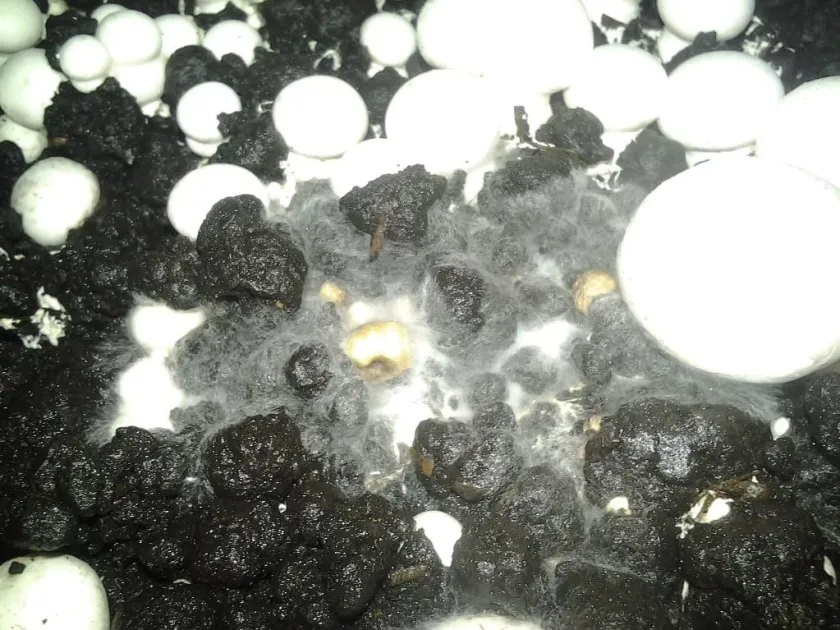
The disease manifests as small, white, fluffy spots on the surface of the mushroom fruit bodies. These spots are initially superficial but expand quickly as the infection progresses.
In later stages, the white mycelium causes the tissue underneath to soften and turn a brownish color. This change in appearance marks the onset of tissue decay and necrosis.
Under a magnifying lens, the surface of the affected area appears powdery, indicating mass sporulation. The mushrooms lose their structural integrity and become slimy to the touch.
Growth of the affected mushrooms is stunted or completely halted, leading to deformed caps and stalks. Advanced cases show total decay of the fruit body, which then releases millions of spores into the room.
An unpleasant, musty odor is often associated with advanced infections, signaling the decomposition of organic matter. This diagnostic feature helps identify the disease before visible widespread symptoms occur.
Pathogen
The causative agent of this disease is the fungus Aphanocladium album, a member of the Hyphomycetes group. It is primarily known as a pathogen that targets commercial mushroom crops.
The fungus develops a white, cottony mycelium that thrives on moist organic substrates. It reproduces through conidia, which are efficiently dispersed by air currents, water splashes, and human activity within the farm.
As a facultative parasite, it possesses high adaptability, allowing it to survive on various organic remains. Its biological cycle is optimized for rapid colonization of host tissues under intensive cultivation conditions.
The organism is characterized by the production of enzymes that degrade chitin and cellulose, facilitating deep tissue penetration. Once established, it can remain dormant in the environment as spores until conditions become favorable.
Genetic plasticity enables the pathogen to withstand many standard disinfection protocols, requiring specialized and rigorous cleaning routines. Its ability to persist in building materials makes it a difficult challenge for growers.
Conditions for development
High relative humidity, typically exceeding 85 percent, is the most critical factor for the development of Aphanocladium album. Such environments prevent surface evaporation and provide a moisture film for spore germination.
Temperature plays a crucial role, with the pathogen thriving in the 18 to 25 degrees Celsius range. This range is frequently used for mushroom growth, making the crop highly susceptible.
Poor ventilation is a major contributor to outbreaks. Stagnant air allows spores to settle and concentrate, creating "hot spots" of infection across the growing room.
Condensation on fruit bodies, caused by temperature fluctuations or humidity management errors, acts as a primary entry point for the fungus. These water droplets facilitate the rapid infection of healthy tissue.
Introduction of the fungus often occurs through infected raw materials or contaminated tools. Once introduced, the pathogen easily exploits overcrowded conditions to spread throughout the facility.
Why it matters
The primary economic impact is the total loss of marketability of the mushroom crop. Fruit bodies affected by Aphanocladium album are unappealing and potentially unhygienic for consumers.
Yield reduction is significant, as the infection can spread quickly through a growing room, destroying the mycelial network. Producers may face total crop failure in heavily infested areas.
Management costs increase drastically due to the need for frequent sanitation, potential loss of substrates, and labor-intensive removal of infected mushrooms. Profit margins are severely pressured by these losses.
Repeated outbreaks lead to the accumulation of spores in the facility, which can cause chronic health issues for the crop. This might eventually force a complete shutdown of operations for deep cleaning.
The indirect costs include damage to the farm's reputation and the loss of potential sales. Implementing strict biosecurity is essential to mitigate these long-term financial risks.
Protection
Strict biosecurity and hygiene are the foundations of successful control. All equipment and tools must be sanitized between sessions to prevent cross-contamination.
- Maintain proper air circulation to keep surface moisture levels low.
- Monitor environmental conditions to avoid condensation on mushroom bodies.
- Promptly remove and safely dispose of any symptomatic mushrooms.
- Use certified, high-quality, and sterilized substrate materials.
- Implement integrated pest management to control vectors like fungus gnats.
Regular sanitation of floors, walls, and shelving units with appropriate disinfectants is vital to reducing spore loads. A clean environment is the best deterrent against Aphanocladium album.
Early detection is key; daily inspections allow growers to contain the spread before the infection reaches the sporulation phase. Targeted spot treatments can prevent the need for broad-spectrum fungicides.
Discussion
No discussions yet — be the first.