
Antrodia vaillantii
Antrodia vaillantii
Description
Symptoms
The first sign of infestation is a change in the color of the wood, which takes on a brownish or tan shade. Over time, the surface of the wood develops cracks running both longitudinally and transversally across the fibers.
In areas of significant mycelial growth, the wood becomes brittle and crumbles easily under light pressure. During final stages, the material turns into dust, losing all its load-bearing properties entirely.
The presence of a white, cottony growth on the surface of wooden beams or boards is a warning sign. Often, deep pockets of decay are hidden beneath this surface growth, remaining invisible until the cladding or flooring is removed.
A specific musty or damp odor often accompanies the active growth phase of the fungus. Even without visible leaks, a feeling of "heavy, damp air" in a room can indicate hidden fungal activity within the structural cavities.
The formation of white mycelial cords running across concrete or stone confirms an infestation by this specific species. This behavior distinguishes it from many other indoor fungi that rely strictly on wood-to-wood contact.
Pathogen
The causal agent of the disease is the basidiomycete fungus Antrodia vaillantii, which belongs to the wood-decaying group. This pathogen is a dangerous pest that causes intense degradation of wooden structures in buildings and various timber constructions.
The mycelium of this fungus is characterized by a high growth rate and the ability to penetrate deeply into the material's structure. It actively degrades cellulose, which leads to a critical loss of mechanical strength in affected structural elements.
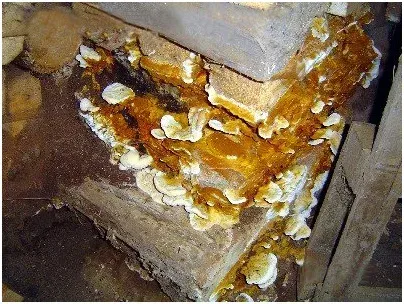
The fungus forms specific fruiting bodies that appear as flat, spreading white patches or cushions. As they mature, they may develop a cream or yellowish hue, which serves as an important diagnostic feature for identification.
In addition to fruiting bodies, the pathogen produces characteristic white mycelial cords or rhizomorphs. These cords can travel long distances over the surface of construction materials, including brick and masonry, to reach new timber sources.
Antrodia vaillantii is classified as an agent of brown destructive rot. Unlike many other species, this fungus exhibits exceptional aggressiveness in closed, poorly ventilated spaces with high humidity levels.
Conditions for development
The primary factor for fungal development is high wood moisture content, which must exceed 20–25%. Condensation, roof leaks, or lack of foundation damp-proofing create an ideal environment for spore germination and growth.
The optimal temperature for mycelial growth ranges from +20 to +25 degrees Celsius. In these conditions, the fungus demonstrates explosive activity, damaging large areas of wooden structures within a single season.
A lack of proper air circulation within buildings promotes moisture accumulation. Stagnant air is a critical factor that allows Antrodia vaillantii to colonize even wood that appears dry on the surface.
Contact between wood and concrete or masonry without an insulating barrier significantly increases the risk of infestation. The fungus utilizes the pores of building materials to transport moisture from the soil to the wooden elements.
The fungus is sensitive to temperature fluctuations and direct sunlight, which is why its primary active sites are always localized in dark, hidden locations under floors or behind wall paneling.
Why it matters
The main danger lies in the rapid reduction of wooden structural strength, which can lead to sudden collapse of ceilings, beams, or roof support systems within buildings.
The fungus has the ability to spread to other wooden items within the premises, including furniture and interior decorations. Its high rate of spread makes it difficult to control without radical intervention.
The economic damage caused by Antrodia vaillantii is related to the complete replacement of affected structural parts. Frequently, entire construction nodes must be removed, leading to expensive and extensive repair work.
Infested wood poses a serious threat to the safety of residents, as the integrity of the surface layer can be misleading while the internal core of the material is completely destroyed.
Fungal spores, which disperse through ventilation ducts, can trigger allergic reactions and respiratory issues in humans and pets staying in an infected building for extended periods.
Protection
The foundation of protection is strict adherence to moisture control rules within buildings. It is necessary to ensure high-quality ventilation in crawl spaces, basements, and attic areas at all times.
Preventive treatment of all wooden structures with deep-penetrating antiseptics is mandatory during construction. The formulations used must contain fungicides specifically active against house-decaying fungi.
Upon detection of an infestation, all affected sections of wood must be removed immediately, including an additional 0.5–1 meter of apparently healthy timber. All removed material must be burned to prevent spore dispersal.
Surfaces adjacent to the infestation sites must undergo deep chemical disinfection. It is crucial to address the root cause, such as repairing leaks, restoring damp-proofing, and ensuring thorough drying of all structures.
Regular inspections of hidden cavities are recommended to monitor the status of the building. If mycelial cords are found, professional fungicidal agents must be applied immediately to ensure complete sanitation of the area.
Discussion
No discussions yet — be the first.