
Antrodia serialis
Antrodia serialis
Description
Symptoms
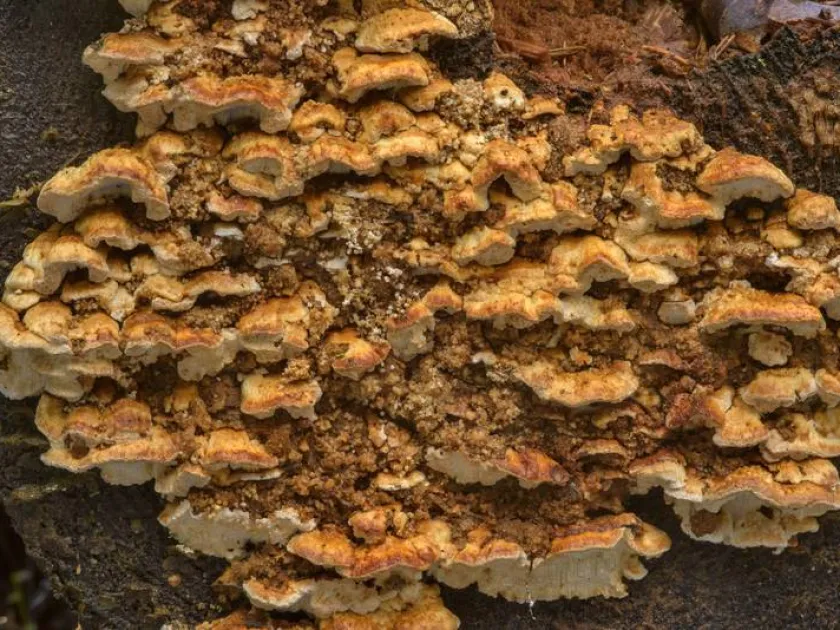
The most evident sign is the appearance of whitish to cream-colored fruiting bodies on the surface of the wood. As they mature, they may darken, but their pore surface remains a key feature to observe.
Affected wood displays severe transverse cracking. As the cellulose skeleton is destroyed, the wood shrinks and breaks into distinct, brittle cubes, which is a textbook example of cubical brown rot.
In advanced stages of decay, the inner wood structure loses its density and can be easily crushed into a fine powder. This structural failure makes the wood completely useless for structural applications.
White, stringy mycelial mats are often visible within the shrinkage cracks of the timber. These mats act as a bridge for the fungus to spread further into healthy tissue, effectively consuming the wood from the inside out.
Tree crowns may show signs of stress, such as yellowing needles or premature leaf drop, as the fungal infection restricts the movement of nutrients and water through the vascular system of the host tree.
Pathogen
The causative agent is the wood-destroying basidiomycete fungus Antrodia serialis (formerly Fomitopsis serialis). It is classified as a saprotrophic and parasitic pathogen responsible for significant brown cubical rot in conifers.
The fungus develops perennial, corky, and resupinate or effused-reflexed fruiting bodies. These sporocarps often grow in long rows along the substrate, which is a characteristic feature for its identification in nature.
Biologically, the fungus utilizes powerful enzyme systems to degrade cellulose and hemicellulose. Lignin is broken down at a much slower rate, resulting in the characteristic brown discoloration and brittle cubical texture of the affected wood.
Spore dispersal occurs via wind, allowing the fungus to infect trees through wounds, branch stubs, or cracks in the bark. Once a spore germinates, the mycelium colonizes the woody tissues, branching deep into the structure.
Antrodia serialis is highly resilient to environmental stress. The mycelium can persist in a dormant state within the wood for extended periods, waiting for favorable moisture levels to resume its destructive activity.
Conditions for development
Antrodia serialis thrives in conditions of high humidity. It is most active in damp, stagnant environments where moisture levels in the wood remain above the fiber saturation point consistently.
The optimal temperature range for growth is +15°C to +25°C. However, the fungus is highly adaptable and can survive in a wide range of temperatures, including sub-zero conditions, which allows it to thrive in diverse forest ecosystems.
Trees that have suffered mechanical damage or are weakened by drought are primary targets for infection. The exposed interior of a broken branch or a wound in the bark provides the ideal moisture and nutrient profile for colonization.
Poorly ventilated timber storage facilities are prime sites for the rapid spread of the fungus. If stacking methods do not allow for adequate airflow, moisture builds up, creating a perfect incubator for the spores.
Using unseasoned, high-moisture lumber in construction without preservative treatment significantly increases the likelihood of Antrodia serialis outbreak within the structural framing of buildings.
Why it matters
The primary damage caused by this fungus is the irreparable loss of structural integrity in timber. It transforms high-quality structural lumber into a brittle, useless mass, leading to massive financial losses in the building industry.
In forestry, the fungus causes rot in living trees, which reduces the total volume of marketable timber per hectare. This forces forest managers to conduct early harvests or salvage logging, which is often less profitable.
Infected trees become hazardous, as the core rot weakens the tree's ability to withstand wind loads, leading to tree failure and potential damage to surrounding infrastructure or forest workers.
The accumulation of infected forest residue—such as stumps, fallen logs, and dead standing trees—creates a reservoir of fungal spores that threatens healthy, younger trees in the surrounding area.
Environmentally, the dominance of Antrodia serialis in certain ecosystems can lead to a simplified microflora, where the natural diversity of wood-decomposing organisms is reduced, impacting nutrient cycling.
Protection
Sanitation is the most critical control measure. Removing infected stumps, dead trees, and hazardous woody debris from the forest floor reduces the spore load and limits the spread of the fungus.
Timber intended for construction must undergo rigorous kiln drying until the moisture content is below 20%. This effectively halts the growth of the fungus and prevents future colonization.
Applying professional-grade wood preservatives is essential for lumber used in outdoor or high-humidity applications. These chemical treatments inhibit the enzymatic breakdown of the wood fibers.
Maintaining clear and well-ventilated storage areas for cut timber helps prevent moisture buildup. Proper stacking techniques, such as using stickers and keeping the lumber elevated, are essential preventative steps.
Regular inspections of wooden structures are recommended to identify signs of rot early. If localized decay is found, affected parts should be removed or treated with specialized fungicidal agents to stop the progression.
Discussion
No discussions yet — be the first.