
Ambrosiella hartigii
Ambrosiella hartigii
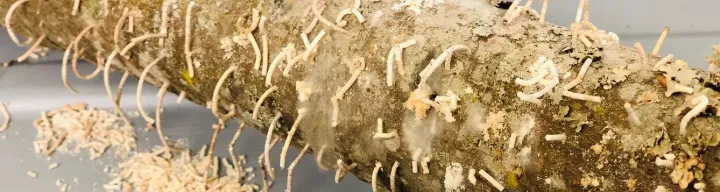
Description
Symptoms
Initial signs of infestation include the appearance of tiny entry holes on the bark, often accompanied by piles of sawdust or "frass" ejected by the boring insects at the base of the tree.
A cross-section of the affected wood reveals characteristic dark staining, often appearing as black or brown streaks. This discoloration indicates the fungal growth spreading through the vascular system.
Trees affected by this pathogen show signs of premature wilting and yellowing of the leaves or needles. This is a direct consequence of the fungus blocking the tree's water-conducting vessels.
Localized necrosis on the bark often develops around the entry points. As the infection progresses, these areas can expand into lesions, potentially leading to the death of branches or the entire canopy.
- Tiny entry holes on the bark (1-2 mm).
- Frass accumulation near the stem.
- Dark staining of the sapwood.
- Dieback of twigs and canopy thinning.
- Decreased leaf turgor and foliage loss.
Pathogen
The causal agent of this condition is the microscopic fungus Ambrosiella hartigii, a member of the ambrosia fungi group. This pathogen maintains a complex symbiotic relationship with wood-boring insects, particularly bark and ambrosia beetles.
The fungus develops inside the galleries carved by beetles within the wood. It serves as a vital food source for the beetle larvae, forming specialized fungal growth zones known as fungal gardens.
Infection initiates when fungal spores are introduced by beetles into fresh wounds or boreholes in the tree. The fungus colonizes the phloem and cambium layers, interfering with the tree's internal circulation.
Ambrosiella hartigii exhibits high enzymatic activity, allowing it to break down complex wood polymers like cellulose and lignin. This process weakens the structural integrity of the affected wood over time.
This fungus is an obligate symbiont, meaning its survival and dispersal are strictly linked to the life cycle and movement patterns of its insect vector, making the insect the primary facilitator of the disease.
Conditions for development
The development of the fungus is highly dependent on environmental conditions, particularly temperature and moisture levels. Warm, humid weather provides the optimal environment for mycelial growth.
Trees suffering from stress—due to drought, physical damage, or other pests—are significantly more susceptible to beetle colonization and the subsequent introduction of the fungal pathogen.
High insect populations in a forest stand increase the likelihood of widespread infection. The mobility of the beetles allows the disease to spread rapidly across large areas of the forest.
Changes in groundwater levels or soil compaction can weaken tree vitality, creating microclimatic niches in the lower stem that are perfect for the establishment of the fungus.
Abnormally hot summers and mild winters contribute to higher beetle reproductive success, which often precedes significant outbreaks of the fungus in tree plantations.
Why it matters
The primary damage is the technical degradation of the wood. The fungal colonization reduces the structural value of timber, rendering it unsuitable for high-quality construction or carpentry work.
Infested trees lose vigor and eventually succumb to the pathogen, leading to localized tree mortality. This creates canopy gaps and disrupts the ecological balance of the forest.
Accumulated deadwood, caused by the death of infected trees, significantly increases the forest fire risk, creating hazardous fuel loads that endanger the remaining forest landscape.
The disease poses a threat to biodiversity, as it specifically targets valuable hardwood species, potentially changing the composition and ecological health of the local forest ecosystem.
Economic losses arise from the need for extensive sanitation logging and the removal of diseased trees, which requires significant operational labor and management costs.
Protection
Sanitation logging is the most effective management strategy. Promptly removing and destroying infected or dead trees reduces the inoculum levels and the population of beetle vectors.
The use of pheromone traps is essential for monitoring and suppressing beetle populations. By keeping vector numbers low, the risk of primary fungal inoculation is greatly diminished.
Preventing mechanical damage to trees during forestry operations is crucial, as any opening in the bark serves as a direct entry point for the fungus carried by boring insects.
In high-value areas, such as urban parks or arboretums, chemical applications targeting the beetles may be used to provide temporary protection during peak flight periods.
Long-term prevention focuses on maintaining healthy forest stands, encouraging tree species diversity, and implementing silvicultural practices that minimize tree stress.
Discussion
No discussions yet — be the first.