
Alder little leaf
Alder little leaf phytoplasma
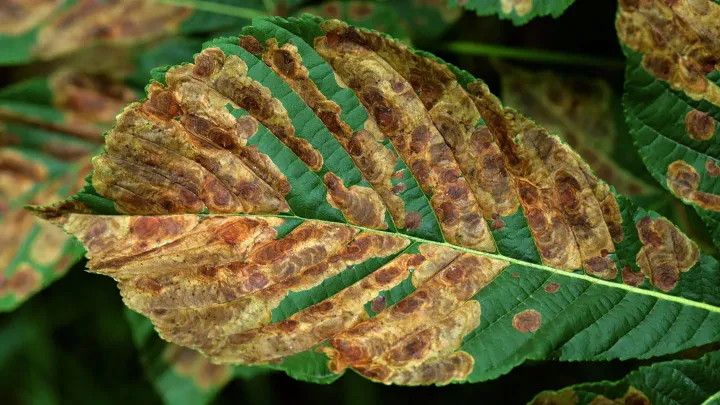
Description
Symptoms
The primary symptom of the disease is the development of leaves that are significantly smaller than normal, often appearing stunted and deformed.
Affected leaves may display chlorosis, a yellowing effect, and a leathery texture that deviates from the healthy foliage of the alder tree.
Shoots often exhibit shortened internodes, leading to a dense, brush-like growth pattern commonly referred to as witches' broom appearance.
The overall tree vigor declines visibly, with the crown becoming sparse and the tree struggling to maintain a healthy growth rate throughout the season.
As the disease progresses, premature leaf drop occurs during the growing season, and dieback of the terminal branches becomes widespread.
Pathogen
The causative agent of Alder little leaf is a phytoplasma, a type of bacteria-like organism that lacks a cell wall and inhabits the plant's phloem.
Phytoplasmas are systemic pathogens, meaning they colonize the entire vascular system of the host plant, disrupting the transport of nutrients.
These pathogens are obligate parasites and are transmitted from tree to tree primarily by phloem-feeding insects, such as leafhoppers.
Once inside the tree, the phytoplasma multiplies and interferes with hormonal regulation, which causes the characteristic growth deformities.
Laboratory diagnosis of the pathogen is complex, often requiring molecular techniques like PCR because these organisms cannot be cultured in standard media.
Conditions for development
The spread of the disease is highly dependent on the presence and density of insect vectors that move between infected and healthy host trees.
Warm and humid climatic conditions favor the survival and rapid reproduction of the insect vectors, increasing the rate of disease transmission.
Trees that are already stressed by environmental factors, drought, or soil nutrient imbalances are more susceptible to becoming infected by the pathogen.
Plantations with low genetic diversity or high tree density facilitate the rapid movement of vectors, leading to localized outbreaks of the disease.
Anthropogenic impacts, such as poor pruning practices or mechanical injury to tree trunks, can create openings that promote infection if vectors are present.
Why it matters
The disease significantly impacts the aesthetic value of alder trees, making it a serious concern for landscaping and urban forestry projects.
By interfering with photosynthesis, the disease forces the tree to deplete its stored energy reserves, leading to gradual decline and stunted growth.
Infected trees become highly susceptible to secondary attacks by wood-boring insects and opportunistic fungal pathogens that thrive on weakened hosts.
The disease causes substantial economic losses in commercial wood production as it renders the wood unsuitable for high-quality timber use.
Ultimately, persistent infection usually results in the death of the tree, which can cause large gaps in forest stands and disrupt ecosystem balance.
Protection
Strict sanitation measures, including the early removal and destruction of symptomatic trees, are essential to stop the spread of the pathogen.
Managing the population of insect vectors through targeted insecticide applications can help reduce the frequency of new infections within a stand.
Choosing healthy, disease-free nursery stock is a critical step in preventing the introduction of phytoplasma diseases into new planting sites.
Implementing regular monitoring programs allows foresters to detect early signs of little leaf disease and initiate control actions promptly.
Promoting a healthy and biodiverse environment improves the tree's resilience to stress and can indirectly limit the impact of the disease.
Discussion
No discussions yet — be the first.