
White rust of crucifers
Albugo macrospora
Description
Symptoms
The most diagnostic symptom of white rust is the appearance of white, chalky, or creamy-white pustules on the underside of leaves. These pustules represent masses of developing sporangia.
On the upper side of the leaf, corresponding to the pustules, yellow chlorotic spots appear. In advanced stages of the disease, these spots may turn necrotic and brown.
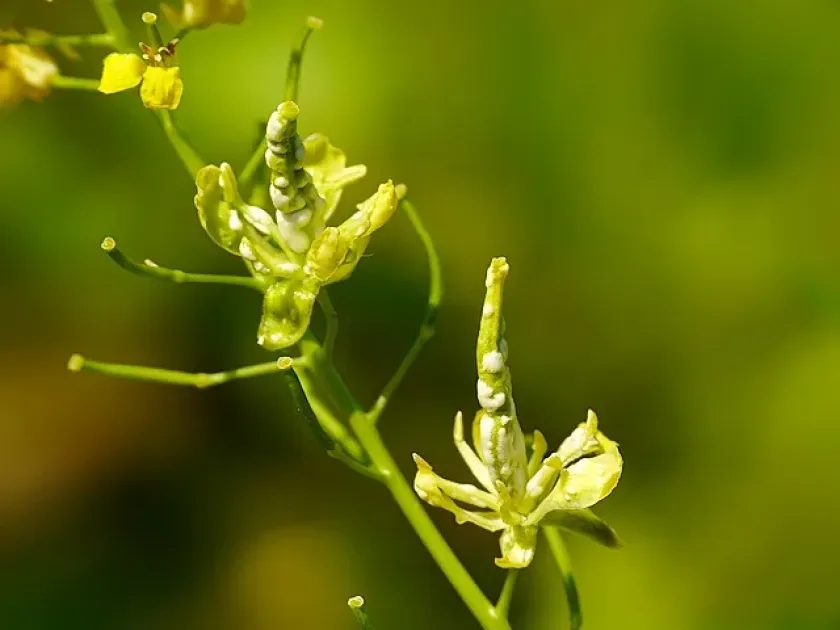
Systemic infection often causes severe distortion, swelling, and twisting of stems, petioles, and flower stalks. This disruption of growth is typical for Albugo infections in sensitive host species.
In seed crops, the development of pods can be severely affected, leading to "staghead" symptoms where the floral parts become distorted and unproductive.
- White, raised pustules on the undersides of leaves.
- Yellow chlorotic areas on the top leaf surfaces.
- Deformed and distorted stems and flower stalks.
- Stunted plant growth and reduced biomass.
- Premature yellowing and leaf senescence.
Pathogen
The causative agent of white rust in crucifers is the oomycete Albugo macrospora. Despite often being referred to as a fungal disease, it is technically an oomycete, which requires moisture to propagate.
The pathogen reproduces via sporangia that release motile zoospores. These spores use water films on the plant surface to move and reach stomata, where they initiate the infection process.
Once inside the host, the pathogen develops intercellular mycelium that utilizes specialized structures called haustoria to absorb nutrients directly from the host plant's cells.
The fungus produces thick-walled oospores, which allow it to survive in soil or crop debris for several years. These oospores are the primary inoculum for new outbreaks in the following seasons.
The disease has a narrow host range limited to plants within the Brassicaceae family, including broccoli, cabbage, cauliflower, canola, mustard, and several common weeds.
Conditions for development
White rust development is highly dependent on humidity. High atmospheric humidity, frequent rainfall, or heavy dew create the perfect environment for spore germination and infection.
The optimal temperature range for the pathogen's growth is between 15°C and 22°C. While it can survive outside this range, the rate of infection significantly slows down in extreme heat.
Poor ventilation within dense crop canopies or greenhouses prevents the foliage from drying, allowing the pathogen to spread rapidly throughout the field from plant to plant.
Over-fertilization with nitrogen can lead to excessive, soft vegetative growth. This succulent tissue is more vulnerable to penetration by the pathogen's hyphae during the early stages of infection.
Weed infestation is a major factor in the persistence of the disease. Weeds like shepherd's purse can harbor the pathogen throughout the year, serving as a reservoir for crop infection.
Why it matters
The economic impact of white rust is substantial, especially in leafy vegetables like mustard or kale where the appearance of the foliage is critical for market value.
By reducing the photosynthetic area of the leaves, the disease directly contributes to reduced yield and slower plant development, which can delay harvests and lower overall quality.
Infected plants are significantly more susceptible to secondary rot-causing pathogens, which often enter through the wounds created by white rust pustules, especially during storage.
Seed production is heavily compromised by this pathogen. Deformed flowers and pods lead to fewer seeds, lower weight, and reduced germination rates, impacting the next season's supply.
Management costs are increased due to the need for chemical applications, which adds to the production cost and necessitates careful management of pre-harvest intervals to ensure safety.
Protection
Crop rotation is the most effective cultural practice. Moving cruciferous crops away from the affected area for at least three to four years helps to reduce the oospore population in the soil.
Sanitation plays a vital role. Removing and destroying crop debris immediately after harvest prevents the pathogen from returning to the soil to complete its lifecycle.
Effective weed management, focusing on removing wild crucifers from the field perimeter and surrounding areas, minimizes the chances of introducing the pathogen into the crop.
Fungicides containing active ingredients specifically effective against oomycetes, such as metalaxyl, can be used as a preventative measure if weather conditions favor the disease.
Planting resistant or tolerant varieties is the best long-term strategy for minimizing the disease's impact. Ensuring adequate plant spacing improves air circulation and prevents moisture buildup.
Discussion
No discussions yet — be the first.