
Benes mushroom
Agaricus benesii
Description
Symptoms
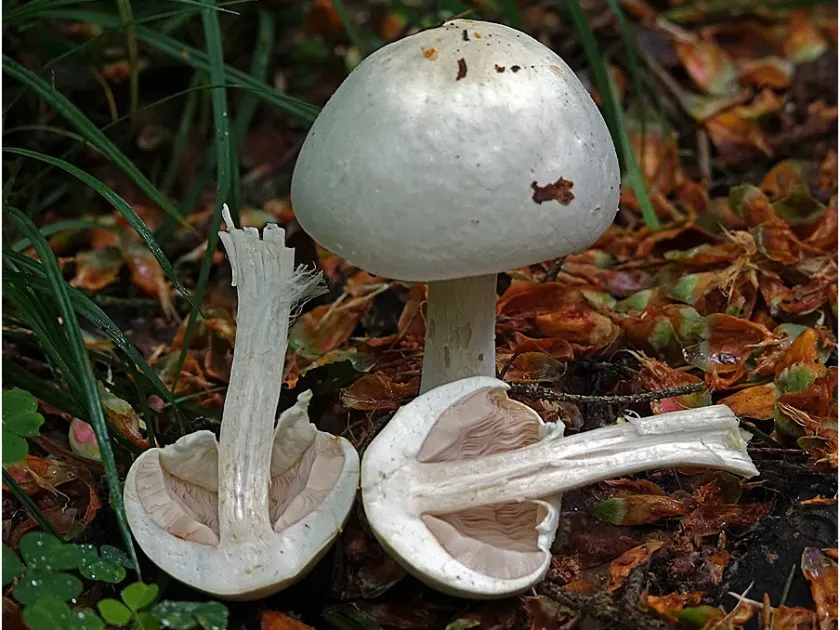
The fruit body typically features a convex to flat cap that is white to cream in color, often marked with small brownish scales on the surface.
A distinctive feature of this species is the rapid reddening of the flesh when cut or bruised, which serves as a primary diagnostic indicator.
The gills are initially pink, transitioning to a dark chocolate-brown color as the spores reach maturity.
The stem is cylindrical with a bulbous base and features a membranous ring, which is a common characteristic of the Agaricus genus.
The mushroom possesses a pleasant, distinct aroma, sometimes described as having a slight almond or aniseed undertone.
Pathogen
The Benes mushroom (Agaricus benesii) is not a plant disease pathogen. It is a saprotrophic basidiomycete fungus that thrives on decaying organic matter.
Unlike phytopathogens, this organism does not attack living plants, crops, or trees, serving instead as a natural decomposer in forest soils.
Its biological cycle is entirely focused on breaking down complex organic compounds, such as lignin and cellulose, into simpler nutrients.
From an agronomic perspective, this mushroom is beneficial as it contributes to soil health and the recycling of forest litter.
There are no protective measures or treatments required for this fungus as it poses no threat to agriculture or horticulture.
Conditions for development
This fungus predominantly grows in coniferous and mixed forests, often found in areas with deep accumulations of leaf litter or organic debris.
It prefers temperate climates where humidity levels remain consistently high, favoring development during late summer and autumn.
The species usually appears in solitary form or in small clusters, thriving in shaded environments where the soil is rich in humus.
Soil pH levels generally tend toward neutral or slightly alkaline, which supports the healthy proliferation of its mycelial network.
The presence of this mushroom is a positive bio-indicator of a healthy, biologically active forest floor environment.
Discussion
No discussions yet — be the first.