
Agaricus (as a competitor fungus)
Agaricus
Description
Symptoms
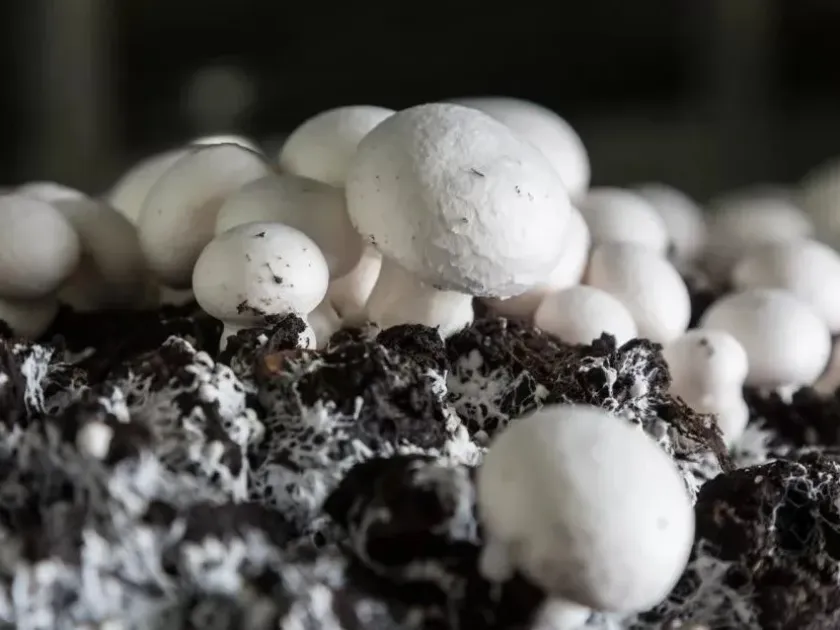
The primary visual sign of infestation is the emergence of a thick, dense white mycelium that grows much faster and more aggressively than the intended mushroom variety.
In the later stages of colonization, the mycelium often forms visible white rhizomorphs (strand-like structures) that permeate the substrate block throughout its entire volume.
As the mycelium matures, it may spontaneously produce small, wild Agaricus mushrooms, identified by a ring on the stipe and gills on the underside of the cap.
The substrate typically emits a strong, authentic mushroom scent, which indicates that the competitor has successfully claimed the nutrients within the block.
Infested blocks will show no growth of the desired mushrooms because the competitor has already exhausted the biological potential of the medium.
Pathogen
In the context of industrial mushroom farming, members of the Agaricus genus can sometimes act as competitor fungi, invading substrate blocks intended for other mushroom species like Oyster or Shiitake.
The pathogen consists of the vegetative mycelium of wild Agaricus strains, whose spores enter the facility through poorly pasteurized substrate materials or contaminated air intake systems.
Biologically, it acts as an aggressive saprotrophic organism that possesses high enzymatic activity, allowing it to colonize organic matter faster than many cultivated mushroom strains.
The relationship between the target crop and Agaricus is characterized by resource competition, where the wild fungus outcompetes the commercial strain by depleting nutrients.
This issue is common in farming operations where thermal treatment of the substrate is insufficient, leaving behind viable spores that exploit the organic medium during the incubation phase.
Conditions for development
Infestation is primarily caused by inadequate heat treatment of the substrate, such as failing to maintain a core temperature of 65-70°C for the required duration.
Optimal growth conditions for Agaricus include high humidity (above 85%) and temperatures between 20°C and 25°C, which are also favorable for many commercial mushrooms.
Poor ventilation control and lack of filtration allow spores to travel through the air, contaminating the incubation area and establishing new colonies.
High moisture content in the substrate combined with poor air circulation can create stagnant zones that are prone to colonization by wild species.
The use of low-quality or stored agricultural waste as a substrate base increases the background load of competitive fungal spores.
Why it matters
The main impact is a total loss of commercial yield, as the competitor fungus renders the substrate useless for the primary crop cultivation.
Economic damage includes wasted investment in raw materials, energy, and labor, alongside the costs associated with the removal and disposal of contaminated substrate.
Once established in a facility, the competitor becomes a source of secondary contamination, constantly shedding spores that threaten subsequent production batches.
Extensive infestations force a complete shutdown of operations for deep cleaning and disinfection, impacting the overall productivity of the mushroom farm.
The resource depletion caused by the competitor leaves the substrate vulnerable to secondary bacterial infections, complicating the disposal process.
Protection
Strict adherence to thermal pasteurization protocols is essential, ensuring the substrate reaches and maintains 65-70°C for at least 8 to 12 hours to kill all foreign spores.
Using high-quality spawn with high growth vigor helps the desired crop establish dominance in the substrate before any potential competitor can take hold.
Installation of high-efficiency particulate air (HEPA) filters in ventilation systems is critical to prevent the ingress of wild mushroom spores.
Rigorous sanitary practices, including the use of footbaths and disinfectant sprays for equipment, are necessary to prevent the cross-contamination of incubation rooms.
- Monitor substrate blocks daily during the incubation period.
- Remove any contaminated blocks immediately from the growing area.
- Maintain clean and dry surfaces in all cultivation rooms.
Discussion
No discussions yet — be the first.