
Welwitsch's forget-me-not
Myosotis welwitschii
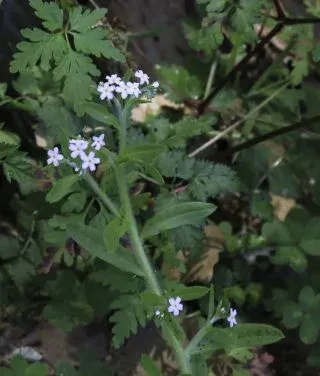
Description
Growing requirements
Welwitsch's forget-me-not (Myosotis welwitschii) belongs to the Boraginaceae family. This perennial herbaceous plant is native to the Iberian Peninsula, particularly Portugal, where it naturally occurs in damp habitats such as riverbanks, marshes, and wet meadows.
Botanically, the plant features slender stems and delicate blue inflorescences arranged in scorpioid cymes. Its root system is well-adapted to moisture-retentive soils, reflecting its evolutionary strategy of colonizing riparian zones where water is abundant.
The cultural requirements demand nutrient-rich, loamy, or silty soils with a neutral to slightly acidic pH. Consistent soil moisture is essential; the plant does not tolerate drought, as its delicate vascular system lacks mechanisms for prolonged water conservation.
Regarding climate, this species thrives in cool, humid environments. It performs best in partial shade, as direct exposure to harsh, midday sunlight can lead to rapid transpiration and leaf scorch, diminishing its overall ornamental quality.
In terms of agricultural and landscape usage, the plant is valued for its ecological contribution to water gardens and moist woodland edges. It is often utilized by landscape designers to provide a soft, blue accent in humid, shaded areas of a garden where other flora might struggle.
Main diseases and pests
Like many species in the Boraginaceae family, this plant is susceptible to fungal pathogens if air circulation is inadequate or humidity remains excessively high. Powdery mildew is the most common issue, appearing as a dusty white layer on foliage.
Gray mold (Botrytis) represents a significant threat during periods of prolonged rainfall or when the plants are grown in overcrowded conditions. Proper spacing is a fundamental agrotechnical measure to ensure sufficient airflow and mitigate the risk of infection.
Slugs and snails pose a consistent threat, particularly to the tender growth during the spring season. Integrated pest management, including the use of physical barriers or natural deterrents, is recommended to preserve the integrity of the leaves and blooms.
Aphids may occasionally infest the shoot tips, leading to stunted growth or deformed flower buds. Early detection through regular monitoring allows for targeted intervention using insecticidal soaps or neem oil, which are generally safe for the environment.
Proactive maintenance involves the removal of dead organic matter after the growing season, which significantly reduces the potential for overwintering of pathogens and harmful insects within the planting site.