
Don salsify
Tragopogon tanaiticus
Description
Growing requirements
Don Salsify (Tragopogon tanaiticus) is a hardy perennial belonging to the Asteraceae family. It is natively found in the steppe regions, known for its ability to thrive in challenging soil conditions such as limestone outcrops.
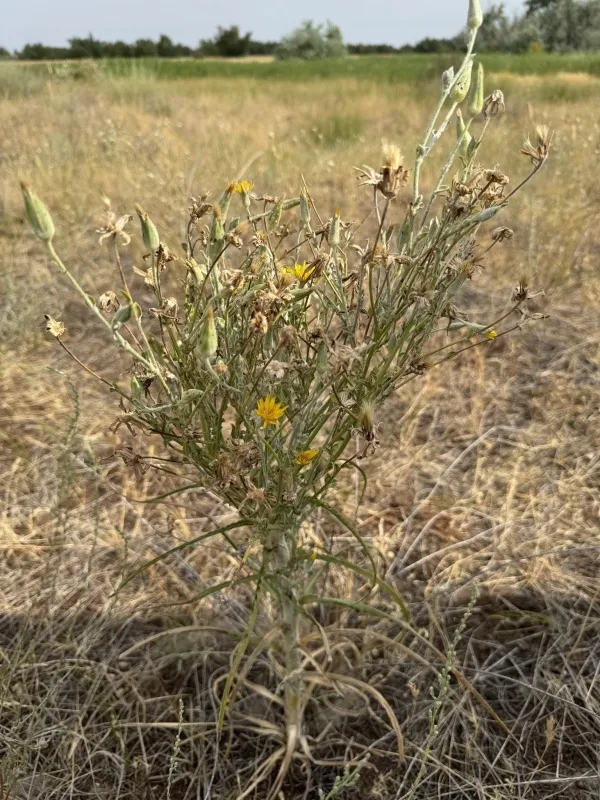
The plant features a distinct taproot system and linear foliage that is adapted to survive with minimal water. It grows typically up to 80 cm in height, with branched stems that support vibrant flower heads.
Regarding soil requirements, it prefers well-drained, alkaline, or neutral soils. It does not tolerate waterlogging, as the taproot is prone to rotting in excessively damp or poorly aerated conditions.
Climate adaptability is one of its strongest traits. It withstands intense heat and periodic droughts, making it a potentially resilient crop for regions affected by climate change or water scarcity.
Agricultural techniques should focus on preparing a fine, weed-free seedbed to ensure successful germination, as seedlings grow relatively slowly in the first few weeks of development.
Main diseases and pests
Common fungal diseases, such as powdery mildew, are frequently observed when the plant is grown in conditions with poor air circulation or high relative humidity.
Pests, particularly aphids, can infest the floral structures and stems during the peak growing season, necessitating close monitoring and potential localized interventions.
Soil-borne pests like wireworms pose a threat to the development of the taproot. Rotation with non-susceptible crops is a key strategy to manage these population pressures.
Leaf rust can appear during cool and wet springs, leading to premature senescence of the foliage and reducing the overall vigor of the plant population.
Management of competitive weeds is crucial during the early growth stages, as the young plants are easily suppressed by fast-growing broadleaf and grass weeds.