
Burchell's ragwort
Senecio burchellii
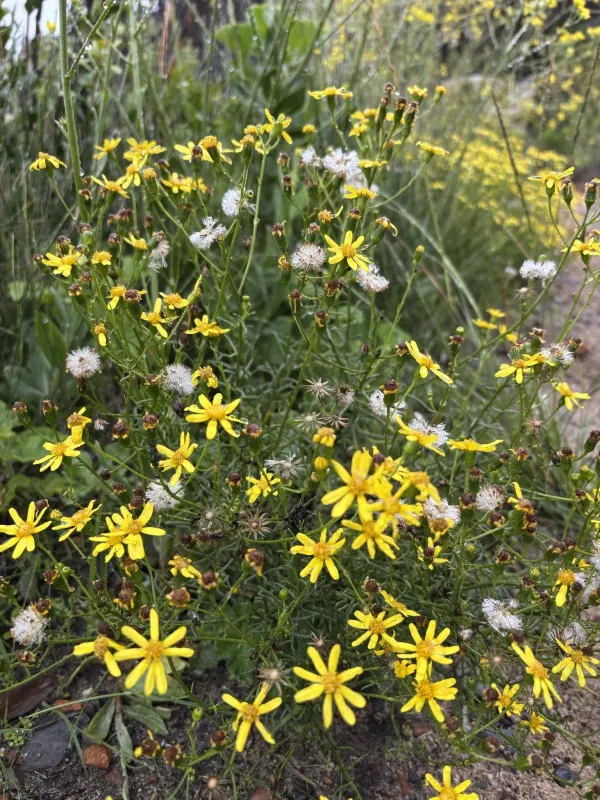
Description
Growing requirements
Burchell's ragwort is a perennial herbaceous plant belonging to the Asteraceae family. In an agricultural context, it is considered a noxious weed rather than a crop, posing a significant threat to livestock and pasture management systems.
Native to South Africa, this species has successfully naturalized in various regions worldwide. It thrives in sunny, open environments, frequently colonizing grazing lands, roadsides, and disturbed soils where competition from desirable vegetation is low.
The plant exhibits high ecological flexibility, adapting well to diverse soil types including those with low nutrient content or poor water retention. Its robust root system allows it to withstand environmental stresses that would typically inhibit other plant species.
Botanically, it is characterized by its upright habit, narrow foliage, and clusters of bright yellow flower heads. The plant reproduces primarily through wind-dispersed seeds, which are produced in large quantities throughout the growing season.
From an agronomic perspective, the most critical aspect of Burchell's ragwort is its inherent toxicity. It contains pyrrolizidine alkaloids that cause irreversible liver damage in cattle and horses, making the plant dangerous even when incorporated into hay.
Main diseases and pests
The primary threat posed by Burchell's ragwort is the degradation of forage quality on pastures. Because the plant is toxic and bitter, livestock avoid it, allowing the weed to propagate unchecked while occupying space that could be used for grazing.
There are very few natural pests or diseases that successfully suppress Burchell's ragwort populations in introduced ranges. Consequently, it remains a persistent problem that requires proactive management strategies from farm operators.
Manual removal is effective for small infestations but must be performed before the plant reaches the flowering stage to prevent seed dispersal. Roots must be thoroughly extracted to minimize the chance of regrowth.
Herbicidal control is the standard practice for managing large-scale infestations. Selective herbicides that target broadleaf weeds are commonly used to reduce the density of ragwort without significantly damaging the surrounding grasses.
Integrated weed management, combining proper grazing rotation with competitive seeding of forage grasses, is essential to minimize the establishment of Burchell's ragwort in agricultural landscapes.