
Feijoa
Feijoa sellowiana
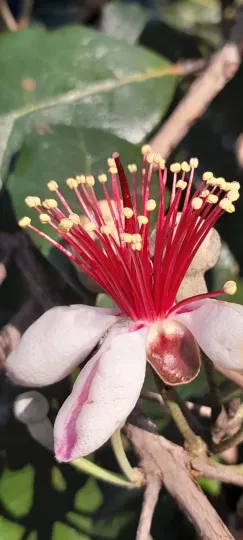
Description
Sowing dates
Propagation of feijoa for both commercial and home orchards is primarily carried out via vegetative methods, including cuttings and grafting, to ensure the preservation of specific cultivar traits.
Seeds are sown in a lightweight, nutrient-rich substrate in late winter or early spring, requiring a stable germination temperature of approximately 20–25 degrees Celsius.
Cuttings are prepared during the summer using semi-hardwood shoots treated with rooting hormones, which allows for the production of saplings ready for transplantation within 1–2 years.
Grafting remains the preferred method for establishing commercial plantations as it significantly shortens the time to maturity and ensures consistency with the desired variety.
Planting saplings in open ground is typically performed in spring after the threat of late frosts has passed, utilizing well-prepared pits with integrated drainage layers.
Growing requirements
Feijoa belongs to the Myrtaceae family and is native to subtropical regions of South America, specifically Brazil, Uruguay, and Paraguay, which dictates its high heat requirements.
The plant thrives in well-lit areas with protection from strong winds, though it can tolerate light partial shade without significant loss in vegetative growth.
Feijoa is relatively undemanding regarding soil conditions, performing best in light loams or sandy soils with a neutral to slightly acidic pH and high humus content.
Consistent moisture is critical, particularly during the flowering and fruit-setting stages, as the plant is highly sensitive to water deficits in the soil.
Moderate temperature regimes are ideal; while the tree can withstand short-term dips down to -10 degrees Celsius, prolonged exposure to severe frost can damage its wood.
Yield
Yield productivity is heavily dependent on the effectiveness of pollination, as most varieties are cross-pollinated, requiring the interplanting of multiple cultivars within a single grove.
Vegetatively propagated trees usually begin producing harvestable yields within 3–4 years, whereas trees grown from seeds may take 6–8 years to bear fruit.
The average yield for a mature, well-managed tree under favorable climatic conditions can range from 20 to 50 kilograms of fruit per season.
Regular maintenance pruning is essential to remove aging branches and stimulate the growth of vigorous new fruiting shoots for sustainable productivity.
Application of balanced mineral fertilizers during the spring and summer periods contributes to improved fruit quality and increased overall crop volumes.
Main diseases and pests
The crop is generally considered resistant to most diseases, though high humidity can facilitate fungal infections such as grey mold or various leaf spots.
Key pests affecting feijoa include soft scales, mealybugs, and spider mites, which feed on the sap of young leaves and tender shoots.
Integrated pest management, including the use of systemic insecticides and preventive rinsing of the canopy with water during hot weather, is highly effective.
Excessive soil moisture can lead to root rot issues, necessitating an immediate assessment of drainage conditions and an adjustment to irrigation schedules.
Routine inspection of the trees and prompt removal of affected foliage are vital preventive measures to inhibit the spread of potential infections across the plantation.
Harvesting
Harvesting usually occurs in the autumn season when the fruits reach technical maturity, indicated by their characteristic size, skin color, and intense fragrance.
Fruits are harvested by gentle twisting from the branch to avoid damaging the skin, which acts as a protective layer during storage and transport.
Readiness for harvest is signaled by the skin lightening slightly and the development of a distinct, aromatic scent that intensifies as the fruit ripens indoors.
Freshly harvested fruit has a limited shelf life at room temperature, so for commercial distribution, fruits are stored in temperature-controlled cold rooms.
The primary uses for the crop include fresh consumption as well as industrial processing into jams, jellies, fruit leathers, and sugar-preserved vitamin blends.