
Sessile oak
Quercus petraea (Matt.) Liebl.
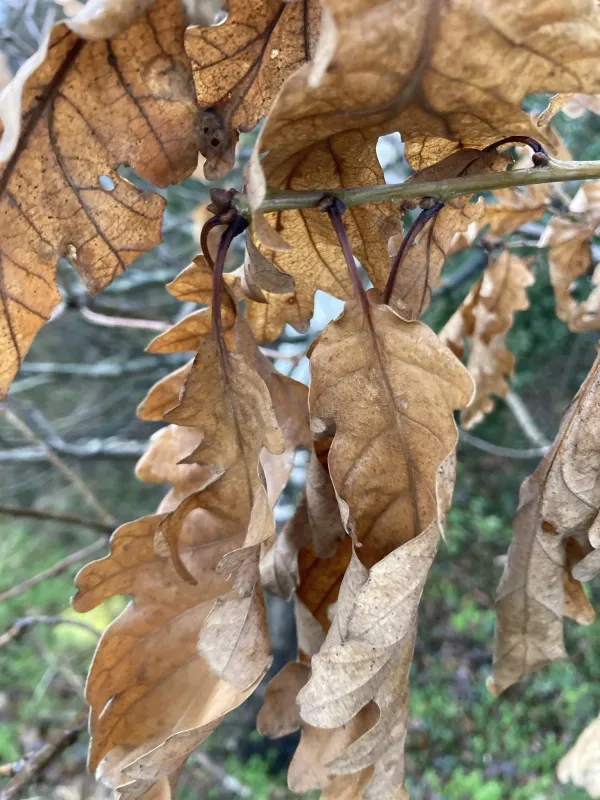
Description
Sowing dates
Sowing acorns of the sessile oak is typically performed in late autumn immediately after harvesting, ensuring the seeds undergo natural stratification in the soil. Spring sowing is feasible only if acorns are stored under climate-controlled conditions to prevent desiccation of the embryo.
Effective forest establishment requires deep ploughing of the planting site to facilitate root penetration. Acorns should be planted at a depth of 5–8 centimeters, which provides protection against rodents and helps establish a stable anchor for the developing taproot.
Industrial planting schemes often utilize row spacings of 1.5 to 2 meters. This density encourages the trees to grow straight and minimizes branching, resulting in higher quality, knot-free timber logs in the future.
Seedlings emerge in late spring and initially focus growth on root development. Weed control during the first three years of life is vital, as the young oak is sensitive to competition from grasses and invasive shrubs.
Mixed-species planting is highly recommended to improve the overall health of the plantation. Incorporating species like lime or hornbeam alongside the sessile oak helps create a forest microclimate that reduces wind stress and improves moisture retention.
Growing requirements
The sessile oak, belonging to the Fagaceae family, is a versatile and valuable forest tree. It thrives in temperate climates and is notably more drought-tolerant than the common English oak, making it ideal for hilly and well-drained terrain.
The species prefers deep, nutrient-rich, and slightly acidic to neutral soils. While it can adapt to rocky slopes, it strictly avoids waterlogged or stagnant soil conditions, requiring good aeration for optimal root performance.
Light management is crucial for the sessile oak. While juvenile trees can tolerate partial shade, the species is essentially light-demanding. Adequate canopy thinning is necessary in mature plantations to ensure the trees reach their full growth potential.
Temperature requirements are moderate, with the species performing best in ranges between 15 and 25 degrees Celsius. It exhibits high winter hardiness but can be susceptible to late spring frosts, which damage newly formed buds and young foliage.
Mycorrhizal symbiosis is fundamental for the sessile oak's nutrition. Maintaining soil health and organic matter is more important than applying synthetic fertilizers, as the roots rely on beneficial fungi to absorb essential minerals from the ground.
Yield
Yield for the sessile oak is calculated based on timber production volume over a long-term rotation period, typically ranging from 80 to 120 years. The timber is highly sought after due to its density and uniform grain structure.
The wood of the sessile oak is considered superior for luxury furniture, high-end flooring, and specialized barrel cooperage for aging wine. Its durability and resistance to decay make it a premium commodity in the timber market.
Average annual growth rates vary based on site quality but generally range from 4 to 7 cubic meters per hectare in well-managed forests. Strategic pruning and density control can significantly increase the percentage of high-value veneer logs.
Beyond timber, acorn production is significant for biodiversity and local wildlife management. Some agroforestry projects integrate oak stands with livestock grazing, providing additional economic value to the land usage.
The long-term investment in sessile oak stands remains one of the most stable and profitable sectors in silviculture, provided that the plantation is protected from external threats and managed for long-term sustainability.
Main diseases and pests
Powdery mildew is the most common fungal disease affecting sessile oak, especially in young plantations. It causes a white powdery coating on leaves, which reduces photosynthetic efficiency and can stunt the growth of young saplings.
Pests such as the oak leaf roller and various weevils can cause significant foliage loss. Integrated pest management, focusing on biological controls and encouraging natural predators, is the preferred method for maintaining large-scale forest health.
Root rot caused by Armillaria species poses a threat to aging or stressed trees. Effective forest management, including the removal of diseased individuals, is necessary to prevent the spread of fungal pathogens through the root systems.
Large mammals, particularly deer, often damage bark and young leaders. Protective fencing or individual tree guards are essential management tools to ensure the successful regeneration of oak stands in wildlife-populated areas.
- Powdery mildew (foliage fungal infection)
- Oak leaf roller (leaf-damaging moths)
- Acorn weevil (pest of the seeds)
- Honey fungus (root rot disease)
- Bark stripping by deer and other ungulates