
Shorea longisperma
Shorea longisperma
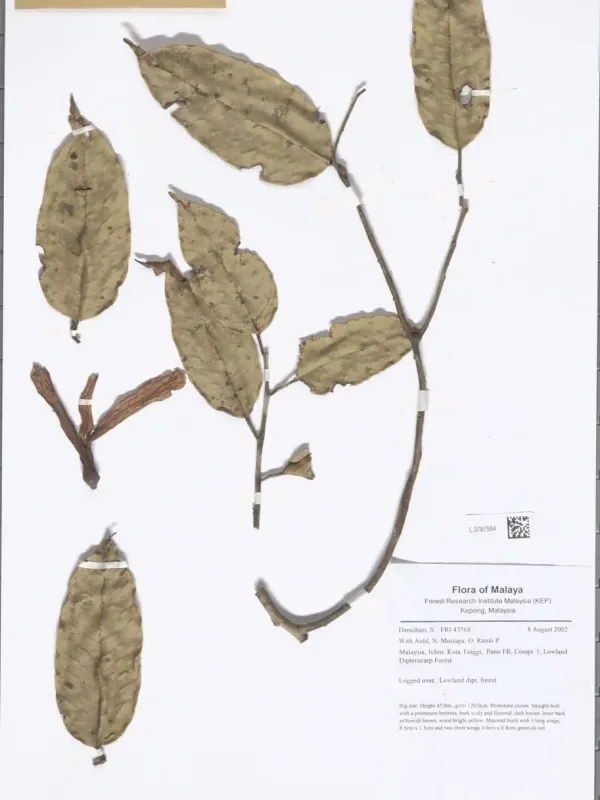
Description
Growing requirements
Shorea longisperma is a prominent member of the Dipterocarpaceae family. It is a large, canopy-emergent tree native to the lowland dipterocarp forests of Southeast Asia, specifically found in regions of Peninsular Malaysia and Borneo.
The tree thrives in tropical climates characterized by high temperatures and abundant rainfall throughout the year. It requires deep, well-draining soil types, typically clay-loam, to support its massive structural growth and deep root system.
As a forest species, it is sensitive to microclimate changes. It performs best in undisturbed primary forest environments where humidity remains consistently high, ensuring optimal physiological activity for the tree's development.
Botanically, it features leathery, evergreen leaves and produces winged seeds, a characteristic feature of the family, which facilitate wind-assisted dispersal. The tree exhibits significant girth and height, often serving as a structural pillar of the rainforest.
The timber produced by this species is highly valued in the global market under the trade name 'meranti'. It is extensively utilized in furniture manufacturing, high-end construction, and cabinetry due to its favorable physical and mechanical properties.
Main diseases and pests
The primary threat to Shorea longisperma is habitat fragmentation driven by large-scale conversion of rainforest land into industrial agricultural estates, particularly for palm oil cultivation.
Pathological issues often arise from fungal infections that target the heartwood if the tree suffers mechanical damage. Proper forest management practices are necessary to minimize structural injury and prevent the spread of decay within the stands.
Insect pests, such as wood-boring beetles, represent a major risk to both living trees and harvested logs. These pests create galleries in the timber, significantly lowering its grade and economic value in the international lumber trade.
Additionally, the slow maturation rate of the species makes it vulnerable to over-harvesting. Without strict adherence to sustainable logging cycles, the natural regeneration of the species cannot keep pace with the rate of extraction.
Climate change poses a long-term risk, potentially altering the rainfall patterns necessary for successful fruit production and seedling survival, thereby threatening the future stability of wild populations of this majestic tree species.