
White-flowered Lumnitzera
Lumnitzera racemosa
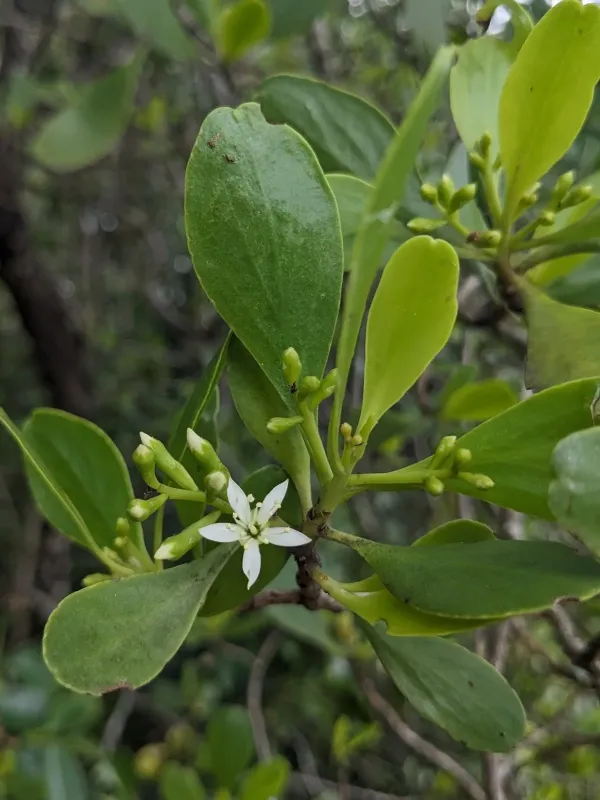
Description
Growing requirements
The white-flowered lumnitzera (Lumnitzera racemosa) is a prominent member of the Combretaceae family, recognized as a vital component of mangrove forest ecosystems. It typically grows as an evergreen shrub or a small tree in saline intertidal zones across the Indo-Pacific region.
This species thrives in muddy, nutrient-rich substrates subjected to regular tidal flushing. It possesses specialized physiological adaptations that allow it to extract freshwater from saline water while effectively managing salt excretion through its leaves.
Climate requirements for this plant are strictly tropical, necessitating consistent warmth and high humidity levels throughout the year. It does not possess mechanisms to endure frost, limiting its distribution to subtropical and tropical latitudes near the equator.
Morphologically, the plant features thick, spirally arranged leaves and small, white-petaled flowers organized in terminal racemes. Its root system is adapted to waterlogged soils, featuring structural elements that facilitate oxygen exchange in anaerobic conditions.
Economically, Lumnitzera racemosa is used for coastal stabilization and bio-shielding against storms. Its wood is highly valued for being exceptionally hard, durable, and resistant to marine borers, making it excellent for traditional construction and tool manufacturing.
Main diseases and pests
The primary threat to the species is the widespread deforestation for aquaculture development, specifically shrimp farming, which leads to the fragmentation and total loss of mangrove habitats.
Oil spills and industrial effluents in coastal areas pose a severe toxicity risk, as chemicals can accumulate in the anaerobic mud and disrupt the plant's metabolic processes.
Several types of wood-boring insects and mollusks can cause significant structural damage to the stems and roots, potentially facilitating secondary infections by opportunistic fungi.
Climate-driven sea-level rise poses a long-term risk; if the rate of sea-level rise exceeds the rate of sedimentation and root growth, the plants may become permanently submerged beyond their tolerance limit.
Competition from non-native or invasive vegetation can also threaten seedling recruitment in areas where natural mangrove regeneration has been hampered by habitat degradation.