
Aizoon hispanicum
Aizoon hispanicum
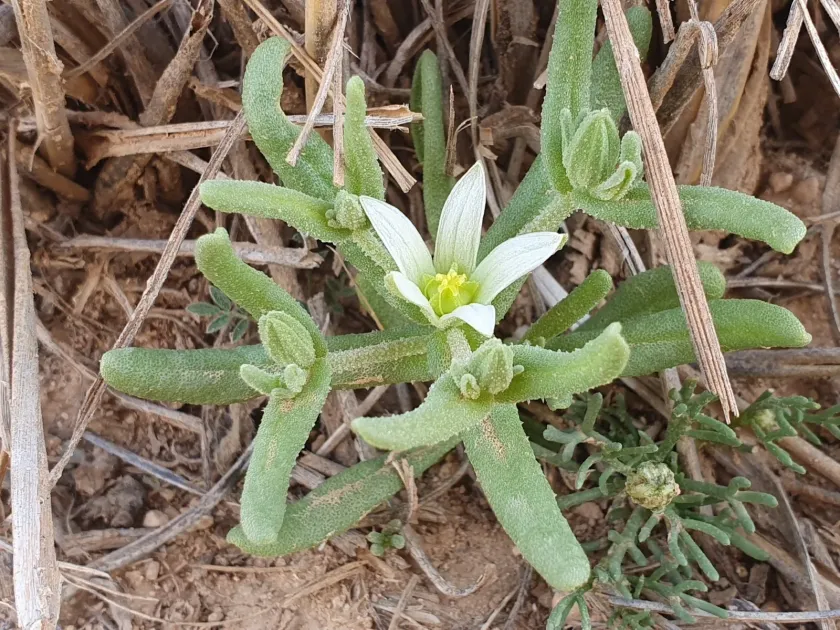
Description
Growing requirements
Aizoon hispanicum is a succulent annual plant belonging to the Aizoaceae family. It is native to the Mediterranean region, North Africa, and parts of the Middle East, where it has evolved to thrive in harsh, arid, and semi-desert environments.
The plant is anatomically designed for water retention, featuring fleshy leaves and a succulent habit. Its ability to tolerate salinity makes it an interesting candidate for research into salt-tolerant crops suitable for marginal, saline-affected agricultural soils.
Regarding climatic requirements, the species demands high levels of direct solar radiation and is highly intolerant of waterlogging. It performs best in well-drained, porous soils such as sandy or gritty loams that allow for rapid drainage after rare rainfall events.
In the wild, it acts as a pioneer species on disturbed or degraded soils, showing resilience to low fertility and extreme temperature fluctuations. Its growth cycle is typically rapid, following the winter-spring moisture availability in its native range.
Agricultural use of Aizoon hispanicum is primarily exploratory, focusing on its potential as fodder in extremely dry conditions and as an ecological restoration agent in degraded coastal or saline ecosystems.
Main diseases and pests
The most significant threat to Aizoon hispanicum crops is fungal rot, specifically root and stem rot caused by poor drainage or excessive humidity. Maintaining proper soil moisture levels is the single most important factor for health.
Aphids represent a common pest threat, as they tend to congregate on the succulent growth of the plant. If left untreated, they can significantly weaken the plant tissue and serve as vectors for secondary viral infections.
Soil-borne pathogens like Rhizoctonia or Fusarium can devastate stands if the soil remains waterlogged for prolonged periods. Crop rotation and seed treatment are recommended strategies for large-scale management of these soil pathogens.
Weed infestation is a major limiting factor during the early growth stages, as Aizoon hispanicum seedlings are slow to establish compared to more aggressive wild grasses. Manual or chemical weeding must be performed carefully to avoid disturbing the root system.
Due to the plant's succulent nature, it is also occasionally prone to infestation by mealybugs, which thrive in protected or greenhouse-grown environments. Periodic inspection of the leaf bases is necessary to monitor and control potential outbreaks.