
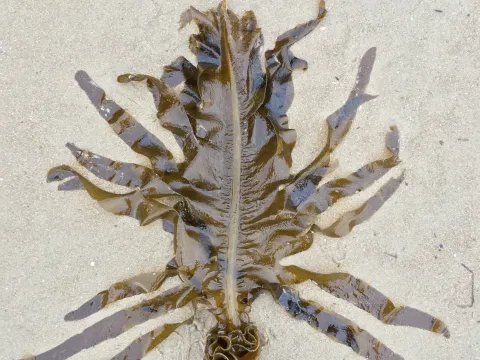
Wakame
Undaria Suringar
The cultivation cycle of Wakame begins in the laboratory where zoospores are settled onto nylon strings. This controlled environment ensures successful germination and the initial development of the gametophytes.
What the section contains

Wakame
Once the juvenile sporophytes reach the required size, the strings are transferred to open-sea environments. This seeding process usually takes place during autumn, when water temperatures align with the optimal growth window.
The strings are attached to horizontal long-lines that are held in place by buoys. These lines are strategically positioned at specific depths to optimize light exposure and nutrient uptake from the sea currents.
Seeding density is a critical variable that farmers must calculate precisely. Proper spacing prevents overcrowding, ensuring that each plant has enough space to mature without competing excessively for nutrients.
Seasonal synchronization is vital; seeding too late may leave the plants vulnerable to spring warming, while seeding too early might disrupt their physiological development during the critical autumn growth phase.
Wakame, belonging to the Alariaceae family, thrives in temperate marine waters. The optimal temperature for rapid growth ranges between 5 and 15 degrees Celsius, making it a perfect winter-to-spring crop.
Salinity management is essential for the health of the culture, with a preferred range of 25 to 35 parts per thousand. Significant fluctuations in salinity, often caused by heavy river runoff, can negatively impact plant vigor.
The crop requires clear, nutrient-rich water. Transparency is crucial for photosynthesis, so farms are typically situated in protected bays where currents provide constant replenishment of nitrogen and phosphorus.
Physical site selection is just as important as chemical properties. Sites must be shielded from extreme wave action and high-velocity currents that could damage the infrastructure or cause mechanical loss of the kelp.
Continuous monitoring of water quality is standard practice. Any presence of heavy metals or pollutants must be strictly controlled, as Wakame is highly efficient at bioaccumulating substances from its environment.
The yield of Wakame varies significantly based on environmental conditions and the intensity of farm management. Efficient operations typically produce between 5 and 15 kilograms of biomass per meter of cultivation line.
The most substantial biomass accumulation occurs during the late winter and early spring. During this period, the plant shows rapid growth, expanding its leaf surface area to maximize light capture.
Advances in selective breeding allow for higher yields by favoring strains that show rapid growth rates and robustness against environmental stressors. Genetic improvement is currently a major focus for commercial mariculture.
Maintaining the farm by removing competing epiphytic growth is a labor-intensive but necessary task. A clean cultivation line directly translates into higher biomass yields at the time of harvesting.
Post-harvest processing, including blanching and immediate freezing, is necessary to lock in the nutritional value and texture of the algae, ensuring the final marketable product meets consumer standards.
Epiphytic organisms, such as smaller algae species and hydrozoans, represent a major biological threat to Wakame crops. These pests compete for nutrients and light, significantly reducing the commercial value of the yield.
Marine herbivores, particularly sea urchins and certain fish species, can cause severe localized damage by grazing on the young tissues of the seaweed, sometimes leading to the total destruction of lines.
Pathogenic outbreaks, often triggered by temperature spikes or poor water quality, can manifest as tissue necrosis or deformations. These diseases are difficult to treat in open-water environments.
Environmental threats include harmful algal blooms, which can starve the Wakame of oxygen or light. These events can lead to rapid mass mortality of the crop within a very short timeframe.
Anthropogenic pollution, including plastic debris and chemical runoff, poses a persistent risk to the quality of the harvested product and the overall sustainability of the marine farm.
Harvesting Wakame is a precise operation performed in the spring, typically before the plant enters its reproductive sporophyll phase. Timing is crucial to ensure the best flavor and texture.
Specialized harvest vessels use mechanized lifting systems to pull the lines from the water, where the seaweed is then cut and sorted by the crew to remove debris and dead tissue.
Speed is the most critical element during the harvest process. The algae must be processed or chilled shortly after being pulled from the sea to prevent the rapid enzymatic degradation of its biological tissues.
The harvest schedule is carefully planned to match the capacity of the processing plant, ensuring that the fresh crop is handled according to strict safety and quality protocols.
Logistical coordination is essential for large-scale operations, allowing for a steady flow of raw materials to the processing facility, where the product is transformed into its final consumer-ready form.