
Swallenia alexandrae
Swallenia alexandrae
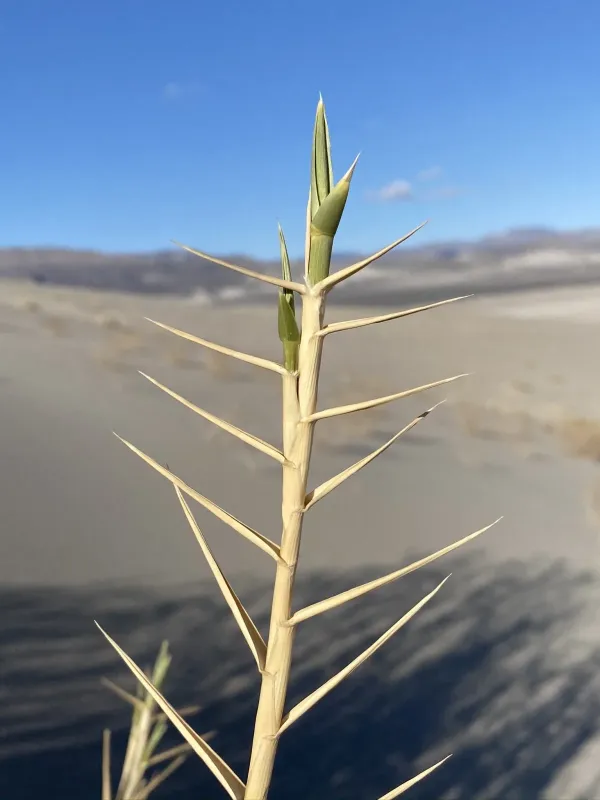
Description
Growing requirements
Swallenia alexandrae, commonly known as Eureka Dunegrass, is a rare member of the Poaceae family. It is a perennial grass endemic to the Eureka Dunes in the Mojave Desert of California, functioning as a specialized plant species adapted to sandy environments.
The plant demonstrates significant biological adaptation to severe desert conditions. It is specifically evolved to survive in shifting sand, with deep rhizomatous root systems that allow it to anchor itself effectively in the unstable substrate of the dunes.
Botanically, it is characterized by its stiff, glaucous leaves and inflorescences adapted to resist desiccation. The morphology of the plant is finely tuned to manage limited water availability, utilizing minimal transpiration surface areas to retain internal moisture during intense heat.
Regarding environmental requirements, this species thrives only in unique aeolian sand deposits. It requires specific soil temperatures and drainage patterns that are impossible to replicate in conventional agricultural fields, meaning it has no status as a commercial crop.
Current utility of Swallenia alexandrae is restricted to biodiversity conservation and ecological research. It serves as a vital indicator of sand dune stability and helps prevent soil erosion in its native habitat, which is why it remains protected by strict environmental laws.