
Maral root
Stemmacantha carthamoides (Willd.) Dittrich
Description
Sowing dates
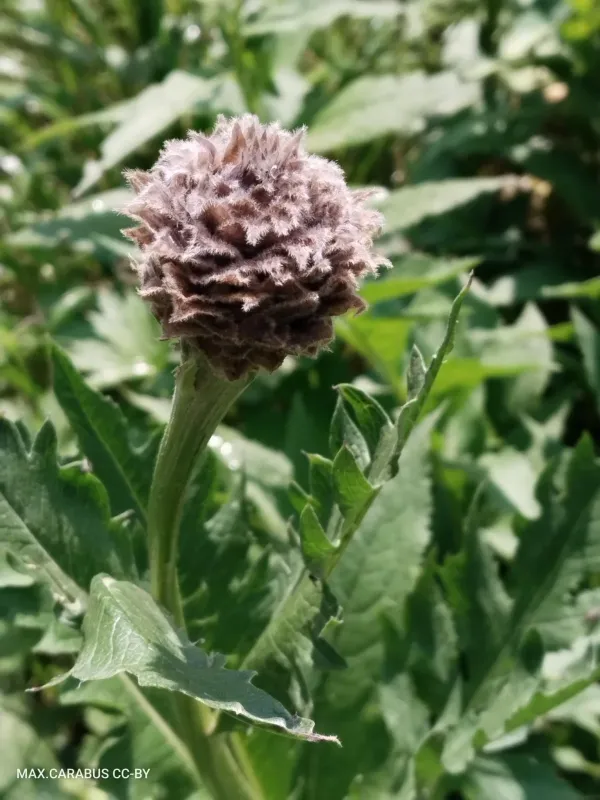
Maral root, scientifically known as Stemmacantha carthamoides, is a perennial herbaceous plant belonging to the Asteraceae family, originating from the high altitudes of the Altai and Sayan mountains.
The optimal sowing time is late autumn, specifically October or November, as the seeds require a period of cold stratification to break dormancy and ensure uniform germination in early spring.
If sowing is planned for spring, seeds must be artificially stratified at temperatures between 0 and 5 degrees Celsius for at least one month to mimic winter conditions and trigger biological processes.
Seeds should be sown at a depth of 2 to 3 centimeters into moist, well-prepared soil to ensure they have enough access to moisture while remaining protected from drying winds during the initial germination phase.
For commercial cultivation, a row spacing of 60 centimeters is recommended, which allows for mechanical weed control and ensures sufficient space for the plants to develop their large root systems over many years.
Growing requirements
Maral root is highly cold-hardy and well-adapted to harsh climatic conditions, making it suitable for temperate regions with significant winter snow cover and short growing seasons.
The crop requires moist soil but cannot tolerate waterlogging, as excessive moisture leads to root rot; therefore, selecting well-drained, fertile soil is a prerequisite for successful establishment.
While it can grow in various soil types, deep, nutrient-rich loamy soils with a neutral or slightly acidic pH provide the best environment for long-term production and high medicinal output.
It is a long-lived perennial that can occupy the same land for over a decade, meaning the initial soil preparation, including deep plowing and the addition of organic matter, is crucial for future yields.
Sufficient sunlight is essential for the accumulation of active compounds, particularly ecdysteroids, so fields should be located in open areas away from heavy forest shade or large buildings.
Yield
The harvest cycle for roots typically begins in the third or fourth year of growth, as this is when the concentration of bio-active compounds reaches its maximum level for pharmaceutical usage.
Yields of dried root material typically range from 1.5 to 3 metric tons per hectare, depending on soil fertility, moisture availability, and the density of the plant population established.
In addition to roots, the aerial part of the plant can be harvested during the flowering phase for use as a potent biomass additive, contributing to the overall economic efficiency of the farm.
Yield stability is maintained by rigorous weed management during the first two years of the crop's life, as Maral root grows slowly during its initial establishment and is easily outcompeted by weeds.
Regular applications of potassium and phosphorus-based fertilizers support root development, which is the primary economic target of this crop, leading to significantly higher market-grade harvest weights.
Main diseases and pests
Wireworms (larvae of click beetles) are among the most significant soil-borne threats, as they can cause extensive damage to the root system, weakening the plant and increasing vulnerability to secondary infections.
Root rot caused by fungal pathogens remains a persistent risk in fields with poor drainage, often requiring careful water management and field leveling to prevent stagnant pools during rainy seasons.
Powdery mildew may occur on the leaves during periods of high humidity and moderate temperatures, potentially reducing the overall vigor of the plants and requiring timely fungicidal intervention.
Aphid infestations can occur during the vegetative phase, necessitating frequent field scouting to apply integrated pest management strategies before populations reach economically damaging thresholds.
Crop rotation is the most effective preventative measure; it is advisable not to replant Maral root on the same site for at least 15 years to break the cycle of host-specific soil pests and diseases.
Harvesting
Root harvesting is performed in the autumn, usually from September to October, after the aerial parts have begun to wither, signaling that the plant's resources have shifted to the underground organs.
Mechanical harvesting is conducted using specialized plows or root harvesters capable of lifting the soil to a depth of 30 centimeters to ensure the extraction of the entire root mass without breakage.
Once harvested, the roots must be thoroughly cleaned of soil and debris, washed in cold running water, and trimmed of all residual foliage before being sent for drying in controlled environments.
Effective drying is carried out in mechanical driers at temperatures between 50 and 60 degrees Celsius, ensuring the preservation of heat-sensitive compounds while reducing the risk of microbial spoilage.
The final product is inspected for quality, packed into breathable sacks, and stored in dry, well-ventilated, and dark warehouse conditions to maintain its shelf life and chemical potency.