
Salsola komarovii
Salsola komarovii
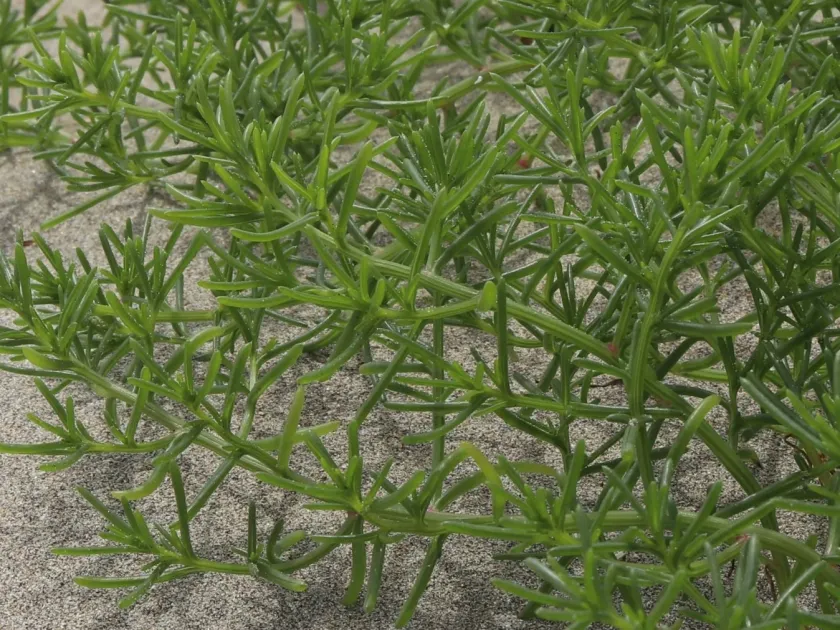
Description
Sowing dates
Salsola komarovii, a member of the Amaranthaceae family, is a herbaceous annual plant known for its remarkable ability to thrive in harsh environments. It is specifically adapted to saline conditions where most standard agricultural crops would fail.
The sowing period is typically scheduled for spring, once soil temperatures consistently reach 10–12 degrees Celsius. In most regions, this period falls between late April and early May.
Seeds should be sown at a shallow depth of approximately 2–3 centimeters. Providing adequate soil-to-seed contact is crucial for achieving uniform germination and establishing a healthy stand from the start.
The seeding rate varies depending on the intended use, generally ranging from 8 to 10 kilograms per hectare. Proper row spacing, if implemented, facilitates maintenance and improves access for weed control.
Once established, the plants demonstrate rapid vegetative growth. They are highly efficient at utilizing available nutrients and moisture, quickly shading the ground and competing effectively with weeds.
Growing requirements
As a classic halophyte, Salsola komarovii exhibits exceptional tolerance to soil salinity. It is capable of absorbing and managing high levels of salt concentrations in the soil without showing signs of physiological stress.
The crop is not demanding in terms of soil fertility, growing well on sandy, clay-heavy, or saline soils. This adaptability makes it an excellent candidate for utilizing marginal land that is otherwise unsuitable for conventional crops.
Abundant sunlight and warmth are the primary environmental requirements for optimal growth. The species is highly drought-resistant, allowing it to maintain metabolic functions even during extended dry periods.
In the early stages, the crop requires careful weed management to ensure that young plants have sufficient space to develop. Once established, the dense growth habit of the plant helps to shade out competing weeds.
Temperature extremes, common in arid or semi-arid climates, do not hinder the plant's development. On the contrary, heat typically promotes more vigorous vegetative accumulation during the peak summer months.
Yield
Under favorable cultivation conditions, the green biomass yield of Salsola komarovii can reach between 150 and 200 centners per hectare. Variations in yield are usually determined by rainfall patterns and the level of soil management.
Harvesting for forage purposes is best performed at the onset of the flowering phase. At this time, the biomass provides the best balance of fiber and nutritional content, ensuring high palatability for livestock.
For seed production, harvesting must occur when the plants reach full maturity, indicated by the characteristic color change of the seeds. Timely intervention is essential to prevent seed shattering in the field.
The primary agricultural use of Salsola komarovii is as a high-quality forage crop for ruminants in water-scarce regions. It is well-suited for ensiling and contributes to balanced animal diets in arid zones.
Additionally, the plant serves as a valuable phytoremediator. By extracting salts from the soil, it assists in gradually improving the quality of the upper soil horizons for future agricultural applications.
Main diseases and pests
Salsola komarovii is characterized by high natural resistance to common plant diseases, significantly reducing the need for chemical fungicide interventions. Most issues arise only under conditions of severe waterlogging.
While pests can occasionally cause minor damage to the vegetative parts, the plant generally maintains robust health. Early monitoring and integrated pest management practices are usually sufficient to mitigate any potential risks.
The most effective strategy for managing potential threats is the implementation of a proper crop rotation system. Alternating Salsola with other crops helps disrupt the life cycles of soil-borne pathogens and insects.
Maintaining the quality of seeds is vital for ensuring the resilience of subsequent crops. Preparing the seeds correctly before planting minimizes the likelihood of vulnerability during the initial establishment phase.
Due to its high evolutionary resilience, the crop remains a highly economical choice for farms operating on challenging terrain. Its minimal need for intensive care translates into lower production costs.