
Common glasswort
Salicornia europaea
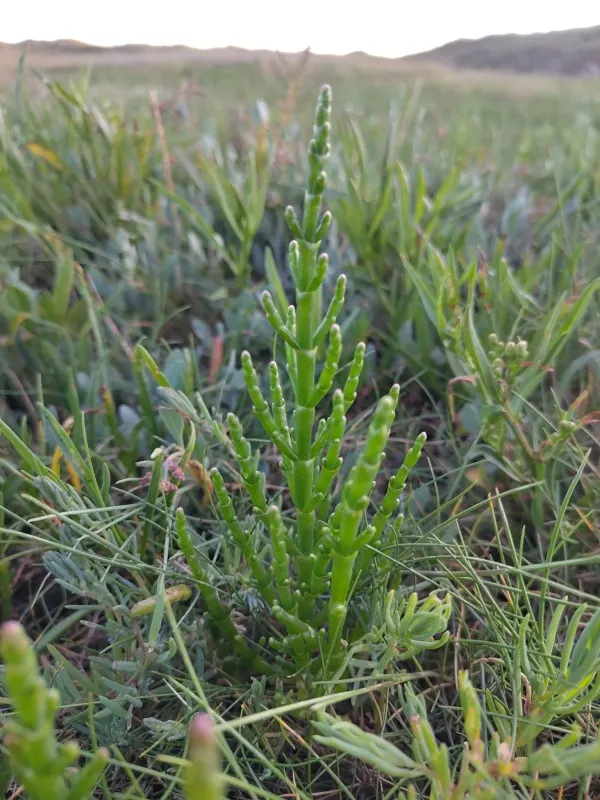
Description
Sowing dates
Sowing of Salicornia europaea is performed in early spring as soon as soil temperatures reach at least 10–12 degrees Celsius. Optimal conditions require adequate moisture to facilitate successful germination of the minute seeds.
Due to the extremely small size of the seeds, they should be sown on the surface and pressed firmly into the substrate. Deep planting significantly reduces germination rates and is not recommended.
Mixing seeds with fine sand at a ratio of 1:10 is an effective technique to ensure uniform distribution across the seedbed. Proper spacing prevents overcrowding and allows for vigorous seedling growth.
Under natural conditions, the plant spreads via self-seeding in late summer. In agricultural settings, controlling seed density is essential for achieving an optimal stand of plants.
Post-emergence thinning is necessary to provide adequate space for the development of fleshy, succulent stems, which are the main commercial part of the crop.
Growing requirements
Salicornia europaea belongs to the Amaranthaceae family and is a specialized halophyte. Its biological cycle is dependent on environments with high salinity, where it thrives while most conventional crops perish.
The primary growth requirement is a saline soil or the availability of brackish irrigation water. Without sufficient salinity, the plant fails to develop its characteristic succulent texture and salty flavor.
The crop is highly light-demanding and thrives in open areas with maximum solar exposure. High levels of sunlight are crucial for the synthesis of nutrients and minerals within the plant tissues.
Optimal temperature for active vegetation ranges between 18 and 25 degrees Celsius. The plant is remarkably adaptable to the temperature fluctuations commonly found in coastal or salt-marsh regions.
Consistent soil moisture is essential for development. While the plant possesses mechanisms to withstand short periods of drought, it performs best on periodically submerged or moist, saline substrates.
Yield
Crop yields for common glasswort depend heavily on the salt concentration in the growing environment and the intensity of irrigation management. Commercial yields can reach 10–15 tons per hectare.
Maximizing productivity involves careful monitoring of the salinity levels in the root zone. A balanced supply of essential mineral elements in the water source contributes to faster biomass accumulation.
Regular harvesting of side shoots allows for multiple cuts during the growing season, effectively increasing the total output per unit area compared to a single harvest cycle.
Genetic diversity of the planting stock also influences yield. Ongoing selection focuses on improving stem thickness and resistance to environmental stress, which enhances the commercial value.
Post-harvest management is critical, as the crop consists primarily of water and minerals, making it sensitive to moisture loss immediately after removal from the field.
Main diseases and pests
Common glasswort possesses strong natural resistance to many common agricultural diseases. Its high tissue salinity acts as a natural deterrent against many pathogenic fungi and soil-borne infections.
Some potential risks include powdery mildew, especially if plants are grown in poor ventilation or overly humid air conditions. Maintaining good air circulation is the best preventive strategy.
Pests rarely pose a threat to Salicornia plantations due to the high mineral content of the stems, which is unpalatable to most typical insect species that attack standard vegetables.
In rare instances, specifically under greenhouse conditions, spider mites may appear during dry spells. Biological control methods are usually effective and sufficient for managing such localized issues.
Maintaining proper drainage to prevent water stagnation is the most effective cultural practice to protect the root system from physiological damage and potential rot.
Harvesting
Harvesting of Salicornia europaea takes place from mid-summer through early autumn. The goal is to collect the tender, succulent stems before they begin to lignify or turn yellow.
Hand-harvesting is the standard practice to ensure that only the highest quality parts of the plant are selected. This selective harvesting maintains the integrity and freshness of the product.
After harvesting, the product must be cooled immediately and kept in controlled environments to prevent wilting. Proper packaging is essential for shelf-life maintenance in retail trade.
In culinary contexts, the plant is known as sea asparagus or samphire. It is highly valued in gourmet kitchens for its crisp texture and natural salty flavor, serving as both a garnish and a vegetable.
Beyond its food use, Salicornia is explored as a sustainable source for biofuels and livestock fodder, particularly in regions where saline soil limits conventional agriculture.