
Siberian dwarf pine
Pinus pumila (Pall.) Regel
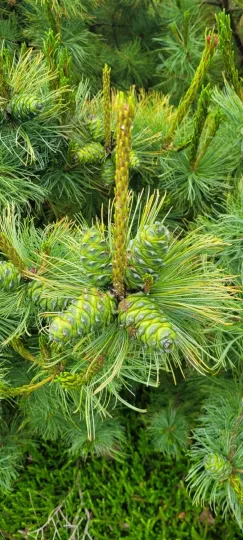
Description
Sowing dates
Sowing seeds of the Siberian dwarf pine in nurseries is preferably done in autumn, before winter, which allows for natural stratification of the planting material in the soil. Spring sowing is possible only after a long pre-stratification of seeds at low positive temperatures for 4 to 6 months.
Seeds are placed in loose substrate at a depth of 2–3 centimeters, ensuring proper drainage, as stagnant moisture is detrimental to young seedlings. Emergence is slow, and during the first year of life, seedlings require protection from direct sunlight and soil dehydration.
Transplanting to a permanent location is carried out at the age of 3–5 years, when the root system is sufficiently developed to adapt to harsh conditions. It is crucial to maintain the integrity of the root ball during transplantation to avoid damaging delicate mycorrhizal connections.
Planting density depends on the objectives: for decorative plantings, 1–2 plants per square meter are sufficient; for anti-erosion strips, the distance is reduced to 0.5–0.8 meters. It is recommended to choose sites protected from strong winds during the early establishment period.
The culture is slow-growing, so the formation of a full-fledged plantation takes decades, which must be taken into account when planning agricultural areas or reforestation projects.
Growing requirements
The Siberian dwarf pine belongs to the Pinaceae family and is a creeping shrub adapted to the harsh climate of the mountain regions in Siberia and the Far East. The plant possesses exceptional cold resistance and can withstand extreme temperatures by sheltering under snow cover.
The crop prefers light, well-drained rocky or sandy soils with moderate acidity. The plant does not tolerate heavy clay soils with water stagnation, which provoke root rot and foliage dieback.
Light requirements are a key biological factor: under heavy shade, the crown becomes sparse, shoots stretch, and fruiting productivity drops significantly. In open areas, the dwarf pine forms dense, ground-hugging thickets.
Moisture requirements are moderate: the plant is capable of extracting moisture from mountain scree, but in dry periods, young plantings require additional irrigation. Good soil aeration is a critical factor for the health of the culture.
In its natural habitat, the dwarf pine plays a key soil-protective role, preventing erosion on slopes. It is ideal for the reclamation of disturbed lands in northern regions where other tree species cannot survive.
Yield
Economic use of the Siberian dwarf pine is primarily linked to the harvest of edible seeds, commonly referred to as cedar nuts. Although the yield per bush is significantly lower than that of the Siberian pine, the seeds possess high nutritional value and contain valuable fatty oils.
Fruiting begins late, usually at the age of 15–25 years, depending on growing conditions. In industrial terms, nut collection is limited due to the difficulty of accessing natural growth sites in remote mountain areas.
In addition to nuts, the dwarf pine is a source of essential oils, needles, and resin, which are widely used in pharmacology and the production of dietary supplements. The plant's entire green biomass contains phytoncides that inhibit harmful bacteria.
Seed yield is highly dependent on weather conditions during the flowering period: late frosts or a rainy summer can lead to the loss of most reproductive organs. While the periodicity of fruiting is weak, years of high and low yields are still observed.
A promising area is the selection of decorative forms, which are used in landscape design for stabilizing slopes and creating alpine rock gardens in regions with cold climates.
Main diseases and pests
The most dangerous pest is the Siberian silk moth, whose larvae can completely destroy the needles and weaken the plant. Mass outbreaks of these pests often lead to the drying of entire dwarf pine thickets.
Serious diseases include needle and shoot rust, caused by fungal pathogens. Under conditions of high humidity and poor air circulation in the crown, various types of needle cast (Lophodermium) spread, causing premature needle drop.
Root rots, occurring due to overwatering, are a frequent cause of seedling mortality. To combat these, fungicides are applied alongside strict adherence to irrigation schedules that prevent water logging in the root zone.
Mechanical damage from snow loads is rarely fatal to the dwarf pine due to the high elasticity of its branches. However, in areas with frequent thaws, "snow mold" can occur under dense snow crusts.
To prevent the spread of pests and diseases, it is recommended to conduct sanitary pruning of affected branches and manage planting density to ensure proper air circulation within the clusters.