
Santolina broomrape
Orobanche santolinae
Description
Growing requirements
Santolina broomrape (Orobanche santolinae) is a highly specialized holoparasitic plant belonging to the Orobanchaceae family. Unlike conventional agricultural crops, it lacks chlorophyll and cannot perform photosynthesis, relying entirely on host plants for its nutritional needs.
The origin and natural range of this species are primarily linked to the distribution of its host plants, specifically the genus Santolina, which is commonly found in Mediterranean and warm temperate regions. It thrives in environments where its host plants are well-established.
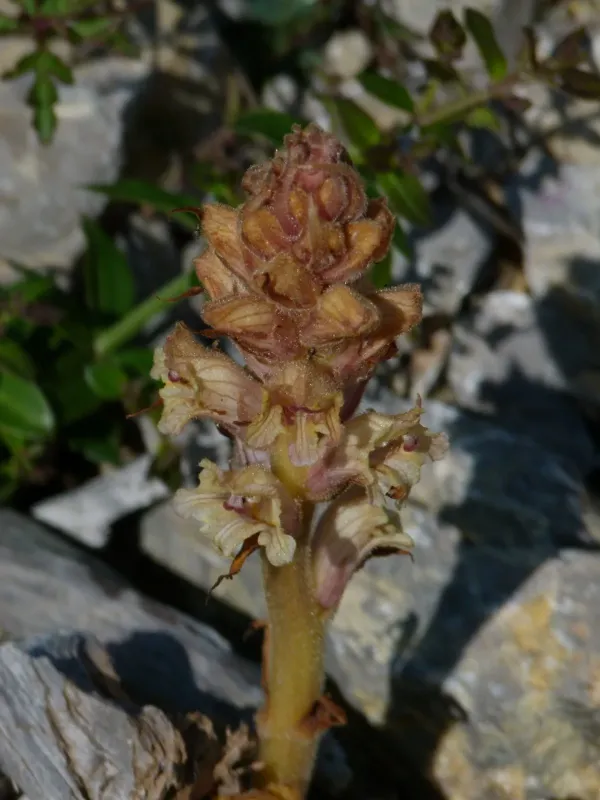
Botanically, the plant is characterized by a reduced structure consisting mainly of a flowering stalk and a root system that develops specialized organs called haustoria. These structures penetrate the host's root tissue to extract vital water and nutrients.
The environmental requirements are minimal due to its parasitic nature, but it shows a preference for well-drained soils where host roots proliferate. Soil temperature plays a crucial role in triggering germination, as seeds respond to specific chemical cues released by host roots.
Agricultural practices for managing this weed focus on crop rotation and the cultivation of non-host species. Farmers must practice strict sanitation and ensure that machinery and tools are cleaned to prevent the spread of microscopic seeds between fields.
Main diseases and pests
The primary threat posed by Santolina broomrape is the significant reduction in host vitality and yield. By diverting energy and nutrients away from the host plant, the parasite stunts growth and can lead to the total collapse of the infested plant.
Disease transmission is an indirect but serious concern, as the parasite can facilitate the entry of pathogens into the host's root system. The vascular connections between the broomrape and the host can serve as a bridge for viral and bacterial infections.
The resilience of the seeds is a major challenge for agricultural productivity. These microscopic seeds can remain dormant for years, creating a long-term threat to any susceptible crop planted in the area, which necessitates a proactive management approach.
Management strategies mainly involve manual weeding of the parasite before the flowering stage to prevent seed dispersal. Once the parasite has flowered, its seeds become widespread, making future control efforts significantly more difficult and labor-intensive.
Chemical control remains problematic, as there are very few herbicides capable of selectively targeting the parasite without harming the host. Integrated pest management, focusing on host-free periods and biological monitoring, is currently the most viable strategy.