
Orobanche cyrnea
Orobanche cyrnea
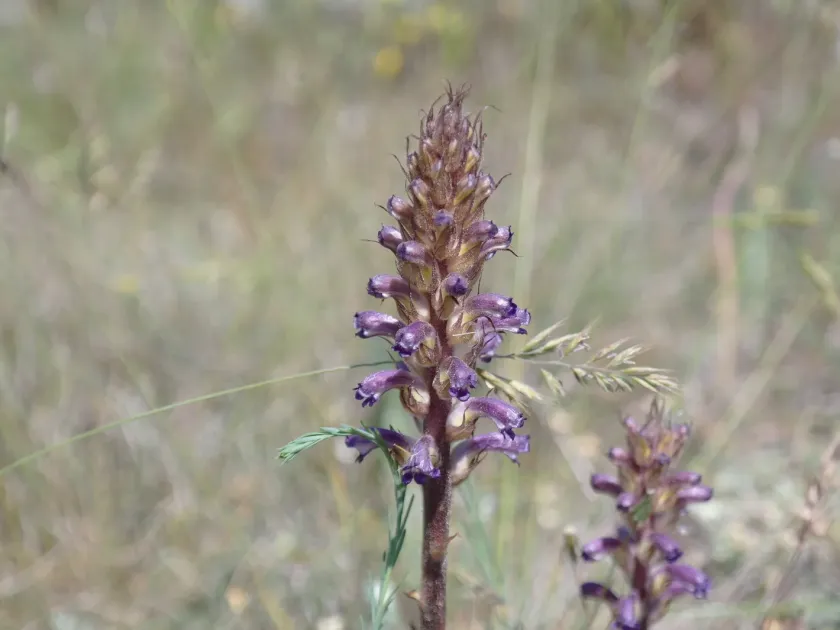
Description
Sowing dates
Orobanche cyrnea is a root parasitic plant belonging to the Orobanchaceae family and is considered a severe agricultural pest rather than a cultivated crop.
The plant lacks chlorophyll and relies entirely on a host plant, attaching to its roots through specialized structures called haustoria to extract nutrients.
The germination of its tiny seeds is triggered strictly by chemical signals (strigolactones) released by the host root system in the surrounding soil.
After germination, the parasite develops a subterranean tubercle that connects to the vascular tissue of the host, allowing for rapid nutrient transfer.
Its life cycle is highly synchronized with the host, ensuring that the parasite produces flowers and seeds precisely when the host is nearing maturity.
Growing requirements
The parasite requires a suitable host plant to complete its biological cycle; without it, the seedlings quickly exhaust their energy reserves and die.
Climatic requirements favor warm, dry regions, as heat and sufficient soil moisture at the right time are necessary for germination and growth.
Soil type is generally secondary, as long as the host plant's root system is present and provides the necessary biochemical triggers for the parasite.
Effective control requires strict agronomic management, including long-term crop rotation with non-host species to deplete the seed bank in the soil.
Proper sanitation of farm machinery is essential to prevent the spread of dust-like seeds from infested areas to clean fields during harvesting operations.
Main diseases and pests
Orobanche cyrnea poses a significant threat to sunflower production, causing direct damage through resource depletion and reduction of crop yield.
The parasitic activity significantly weakens the host plant, making it more susceptible to other diseases and environmental stress such as drought.
The high fecundity of this plant means that even a minor infestation can lead to widespread contamination of fields within a few growing seasons.
Integrated pest management (IPM) is the only viable approach, as reliance on a single method often leads to the development of more virulent races.
- Use of resistant hybrid cultivars.
- Application of herbicide-tolerant crop technologies.
- Chemical soil treatment in severe cases.
- Manual removal of flower stalks before seed maturation.