
Orobanche camptolepis
Orobanche camptolepis
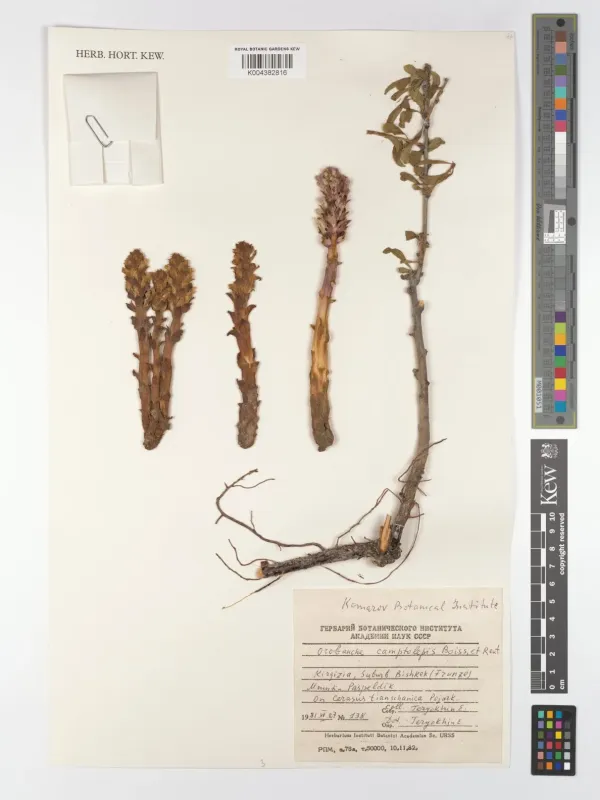
Description
Growing requirements
Orobanche camptolepis is a parasitic plant species belonging to the Orobanchaceae family. As a holoparasite, it lacks chlorophyll and relies entirely on host plants for its nutritional needs, attaching itself directly to the roots of its host.
The native distribution of this species spans arid and semi-arid landscapes, particularly in parts of Central Asia and the Caucasus. It is highly adapted to environments where water availability is a limiting factor for plant growth.
The biology of Orobanche camptolepis centers on the production of microscopic seeds that can remain dormant in the soil for years. They detect chemical signals, specifically strigolactones, released by the roots of a potential host plant to trigger germination.
Regarding soil preferences, it thrives in well-aerated, often coarse-textured soils that allow for efficient chemical communication between the host roots and the parasite. It avoids waterlogged areas that may inhibit the initial stages of parasitic attachment.
Effective agricultural management requires integrated approaches such as crop rotation with non-host species, soil solarization, and the selection of host cultivars that possess genetic resistance to prevent the haustorial attachment of the parasite.
Main diseases and pests
The primary threat posed by Orobanche camptolepis is the significant nutrient deprivation of the host plant, which frequently leads to stunted growth, reduced photosynthetic capacity, and overall crop failure.
Natural biological control agents include specific insects like Phytomyza orobanchia, which feed on the reproductive parts of the broomrape, and various fungal species that can infect the parasitic tissue.
Excessive spread of the parasite can lead to a total loss of agricultural productivity in infested fields, necessitating rigorous field sanitation and the prevention of seed dispersal through farm machinery.
Integrated Pest Management (IPM) strategies for this species emphasize maintaining soil health and using crop varieties that are non-inducive to the germination of broomrape seeds.
Research continues into finding selective herbicides that can target the broomrape attachment process without inflicting phytotoxic damage upon the target agricultural crop being protected.