
Mousetail
Myosurus minimus
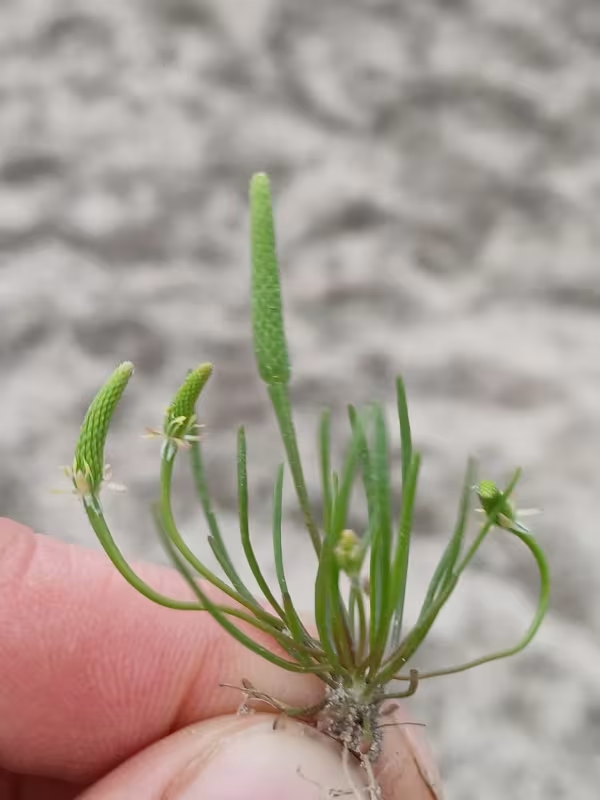
Description
Growing requirements
Mousetail (Myosurus minimus) is a small annual herbaceous plant belonging to the Ranunculaceae family. It is easily identified by its unique, elongated receptacle that resembles a mouse's tail, giving the species its common name.
The plant has a wide distribution across the temperate regions of Europe, Asia, and North America. It typically inhabits moist, open habitats and disturbed soils, making it a common sight on agricultural lands.
Climatic requirements focus on cool, damp conditions. The species thrives in areas with high soil moisture and is frequently found in fields with poor drainage or clay-heavy soils where water tends to pool.
Botany-wise, Myosurus minimus is a fast-growing ephemeral. It completes its lifecycle rapidly during the early spring season, ensuring seed production before the onset of drier summer conditions.
Agronomic management is rarely focused on this plant directly, but its presence serves as an indicator for landowners to evaluate field drainage and soil moisture management strategies.
Main diseases and pests
There are no significant economic pathogens or pests that specifically target the mousetail plant, as it is considered a wild botanical species rather than a crop.
The primary threat posed by this plant is its ability to compete with seedling crops, specifically winter cereals, for available moisture in the early spring months.
While the biomass of individual plants is low, high densities can lead to localized nutrient depletion, which may slightly impact crop uniformity in water-logged patches.
Standard weed control involves tillage practices such as shallow cultivation or harrowing, which effectively destroys the plants before they reach the flowering stage.
Chemical control via herbicides is seldom necessary for this species, as good field sanitation and drainage improvements are usually sufficient to mitigate its impact on crop yields.