
Field cow-wheat
Melampyrum arvense L.
Description
Growing requirements
Field cow-wheat (Melampyrum arvense L.) is an annual herbaceous plant classified within the Orobanchaceae family. It is distinct for its semi-parasitic nature, utilizing specialized organs called haustoria to derive water and essential nutrients directly from the root systems of surrounding cereal crops and wild grasses.
The native range of this species extends across Europe, the Caucasus, and parts of Western Asia. It typically thrives in open, sun-drenched environments such as meadows, fallow lands, and agricultural margins where it can easily establish connections with host plants that provide the necessary resource support for its growth.
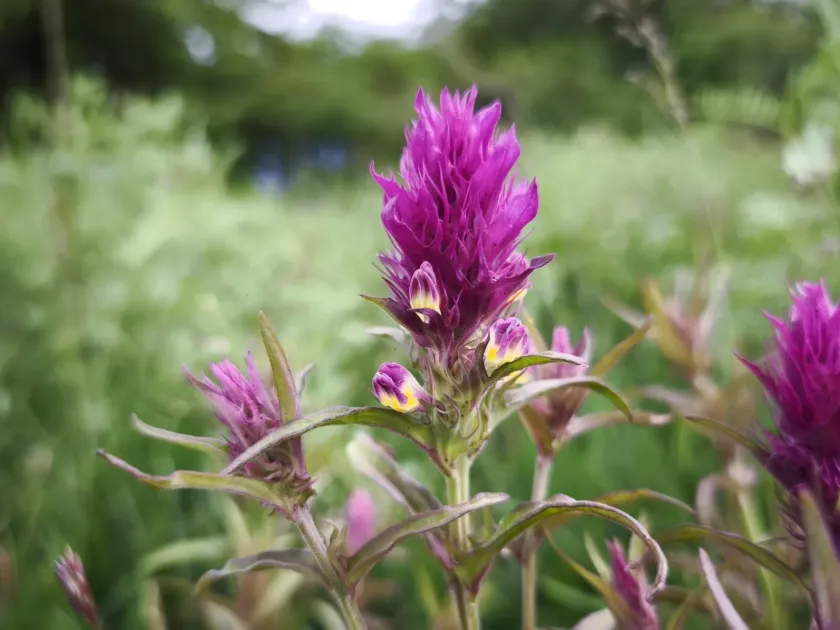
Botanically, the plant is characterized by its visually striking spikes of yellow flowers protected by vibrant violet or pink bracts. This unique coloration often makes it a prominent feature in fields during the early summer season, growing alongside wheat or rye, where it can reach a height of up to 50 centimeters.
Regarding environmental requirements, field cow-wheat favors well-drained, moderately fertile soils. While it can photosynthesize independently, the parasitic link to a host plant significantly enhances its reproductive success. Consequently, agricultural landscapes with consistent crop density provide an ideal setting for its development.
In terms of agricultural management, field cow-wheat is categorized as a noxious weed rather than a crop. Due to the damage it inflicts on cereal yields, farmers rely on strategic crop rotation, mechanical soil cultivation, and selective herbicides to prevent it from establishing strong populations within the main field plots.
Main diseases and pests
Common threats to field cow-wheat in the field environment include mechanical disturbance and competition with more aggressive invasive species. While it is rarely targeted by specific biological agents in modern agriculture, it can occasionally be affected by generalist fungal pathogens such as rusts or mildews, especially in dense plant communities under high humidity.